Five AI pentest agents compared: ARTEX, PentAGI, HexStrike, CyberStrikeAI and CAIRN

The same five names keep recurring in this autumn’s coverage: Google gathers them in its threat tracker, Elastic reviewed their code, and each alert covers its own case. I checked them against the same primary sources the reports use: what each thing actually is inside, what licence it carries, and what none of these documents prove.
On November 13, 2026 the FBI published its FLASH alert on ARTEX, an AI-agent pentest framework that various malicious actors have been using since at least August. Three days later, Google Threat Intelligence Group wrote in its AI Threat Tracker (published November 16 per its metadata; the header shows November 17) that it had observed attackers automating vulnerability discovery and exploitation with no human in the loop for the first time.
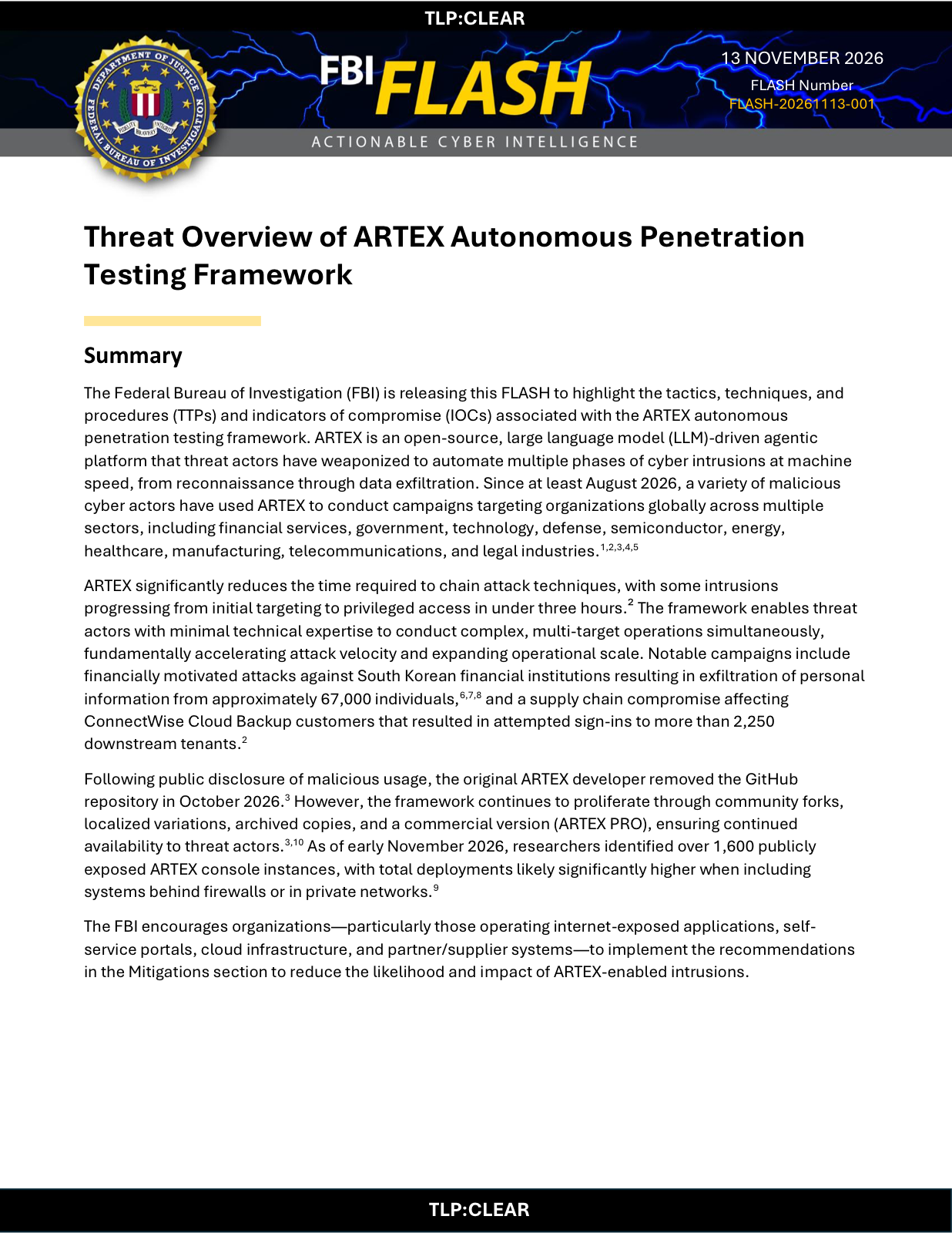
First page of FBI alert FLASH-20261113-001, marked TLP:CLEAR (unrestricted distribution). It is the original document downloaded from ic3.gov, not a generated image.
The same names recur: ARTEX, PentAGI, HexStrike AI, CyberStrikeAI and CAIRN. This article checks them against the primary sources the reports use: READMEs, alerts, threat-intelligence articles and press releases, with a date and a link for every figure.
One note on names. In the list that prompted this article, the fourth name was “Pentagon”. No product exists under that exact name in the autonomous pentest category: the GitHub search with the topic pentagon returns zero repositories, and the only namesake is Pentagon Infosec, a VAPT services firm with human testers. The one that fits by name and category is PentAGI (Penetration testing Artificial General Intelligence), the vxcontrol system that appears alongside the other four in the reports cited below.
Why these five exactly?
It is not a popularity list. The five appear together in dated, verifiable third-party documentation:
- Google GTIG, on November 16, 2026, observes CAIRN and PentAGI deployed in real operations, CyberStrikeAI and HexStrike AI at the experimentation stage, and describes active leveraging of ARTEX.
- Elastic Security Labs published on November 13, 2026 a source-level analysis of five offensive agentic frameworks, with detection scenarios.
- WIRED, on November 18, names four of the five among the frameworks researchers mention frequently, and reports GitGuardian’s count: 45 distinct attack frameworks documented so far.
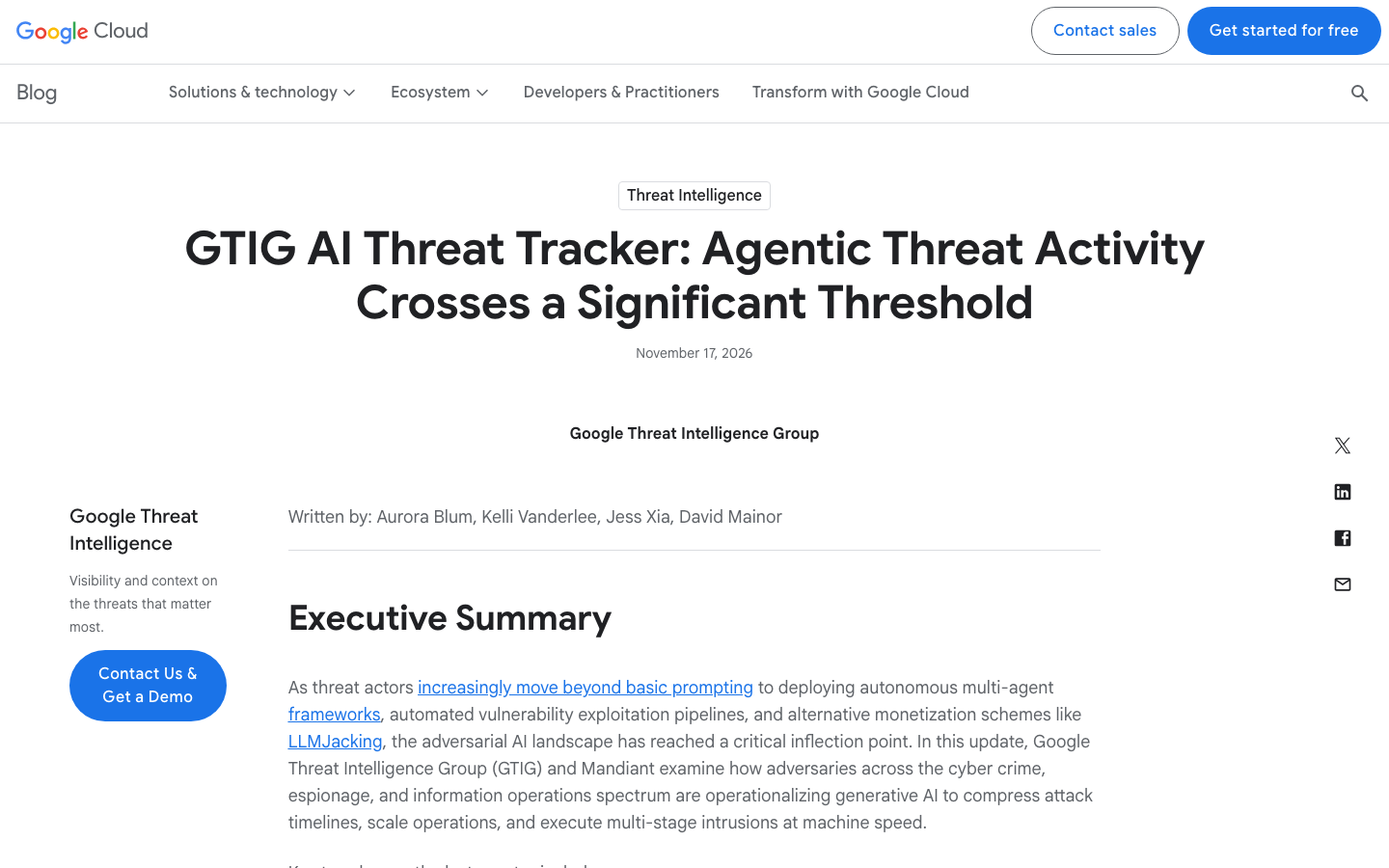
Real capture of the header and executive summary of Google Cloud’s “GTIG AI Threat Tracker” article. Its metadata dates the article to November 16, 2026; the printed header shows the 17th. It is a Google page, not a generated image.
There are prior comparisons: Stingrai compared four open agents on November 13, but excludes ARTEX, whose original repository no longer exists. Mine starts from the five that recur in this autumn’s threat-intelligence literature.
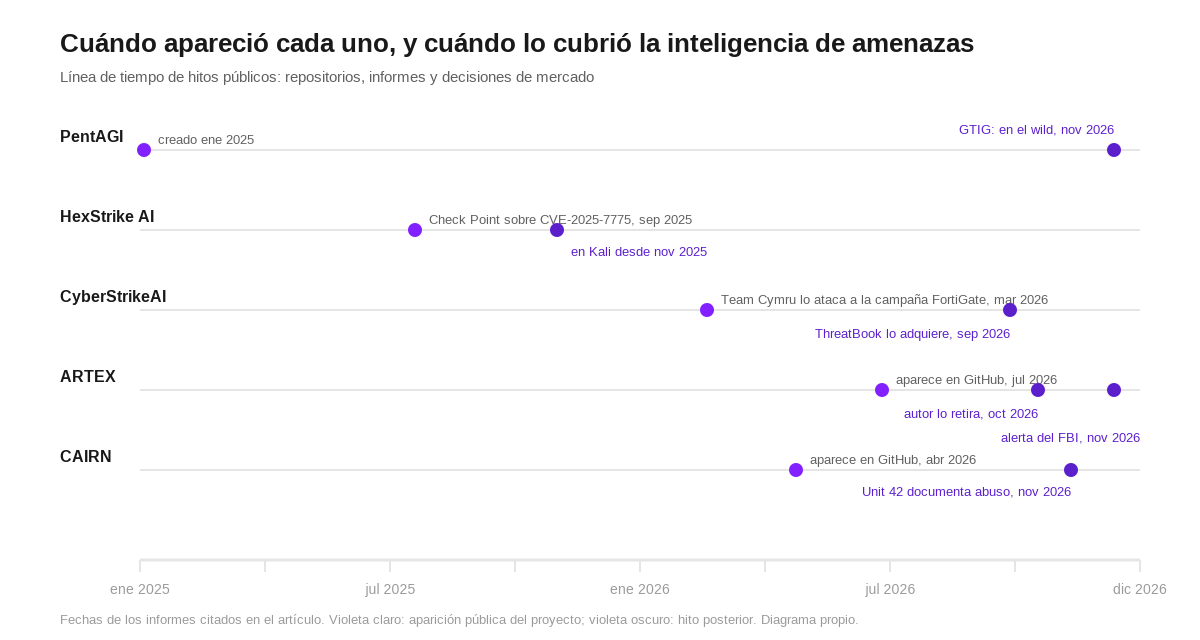
Own diagram with the dates published by each source cited in the article. It is not an image from the FBI, Google or any vendor.
What each one does inside
ARTEX: the planner that survived its own removal
ARTEX is a multi-agent autonomous pentest platform written in Go, per the FBI alert. A planning agent breaks the objective into attack intents and several worker agents run real tools over a shared graph; results stay bound to their evidence. Elastic read the source of all five frameworks, and Talos, on November 13, and CERT-EU, on November 5 describe it the same way.
Its history in numbers: it appeared on GitHub in July 2026 under the pseudonym Autumn-27; on October 8 the original repository stopped being available and its author announced the project would go closed source. The FBI summarizes the malicious use as “from targeting a system to active compromise in under three hours”. GTIG observed in its incidents a path from first account to deep access of around four hours, and one case at 15 minutes.
What remains are forks: the active continuation BaaRai/ARTEX measured 19,601 stars on November 25, 2026 (GitHub API), and a hosted console at artex.lol publishes prices of 29, 79 and 249 dollars per month (vendor figures). That console documents no relationship with the original project: its GitHub mirror returns 404.
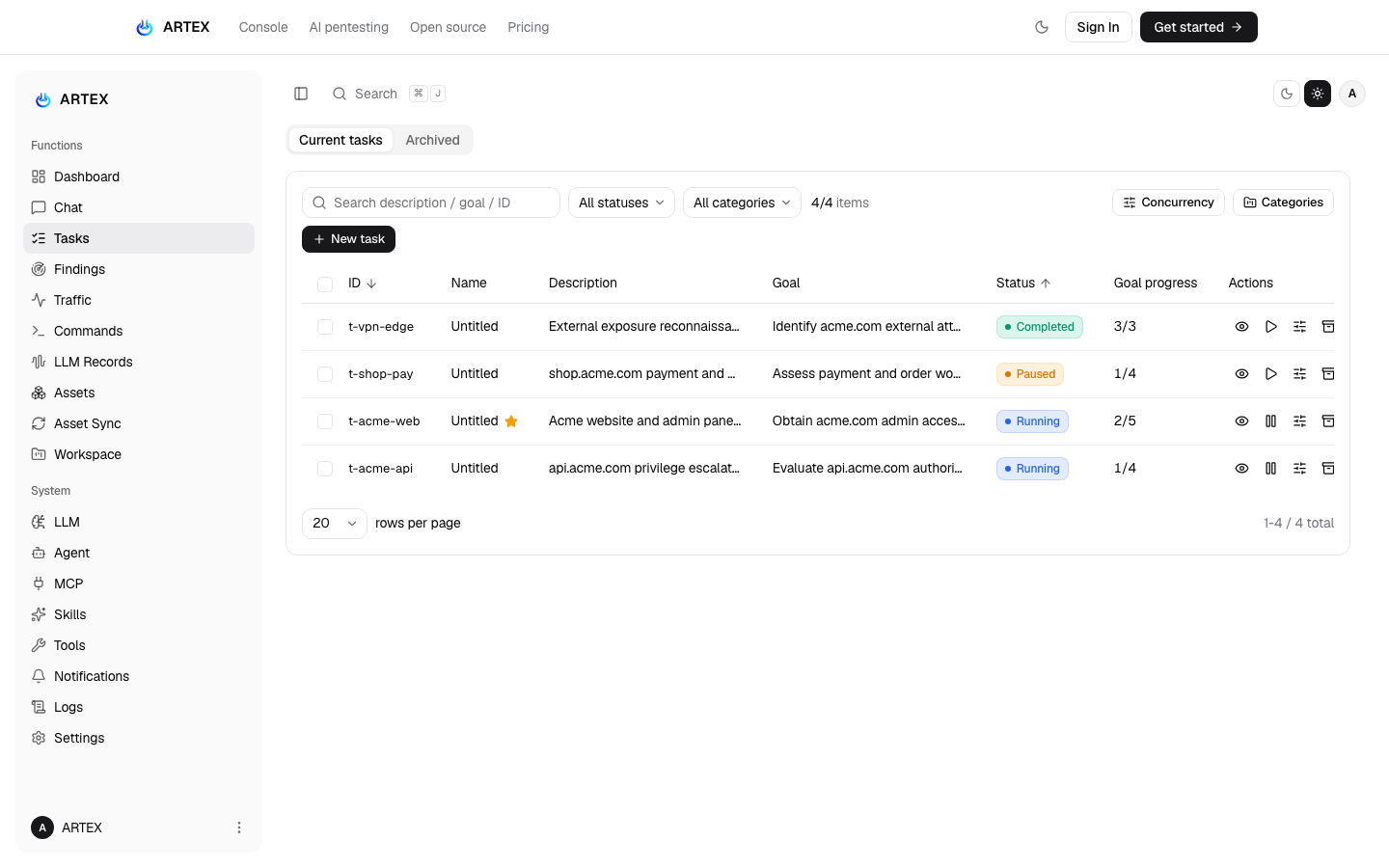
Real capture of artex.lol taken on November 25, 2026. It is the vendor’s interface, not a generated image; the use is editorial to illustrate what we are discussing, with no association or endorsement.
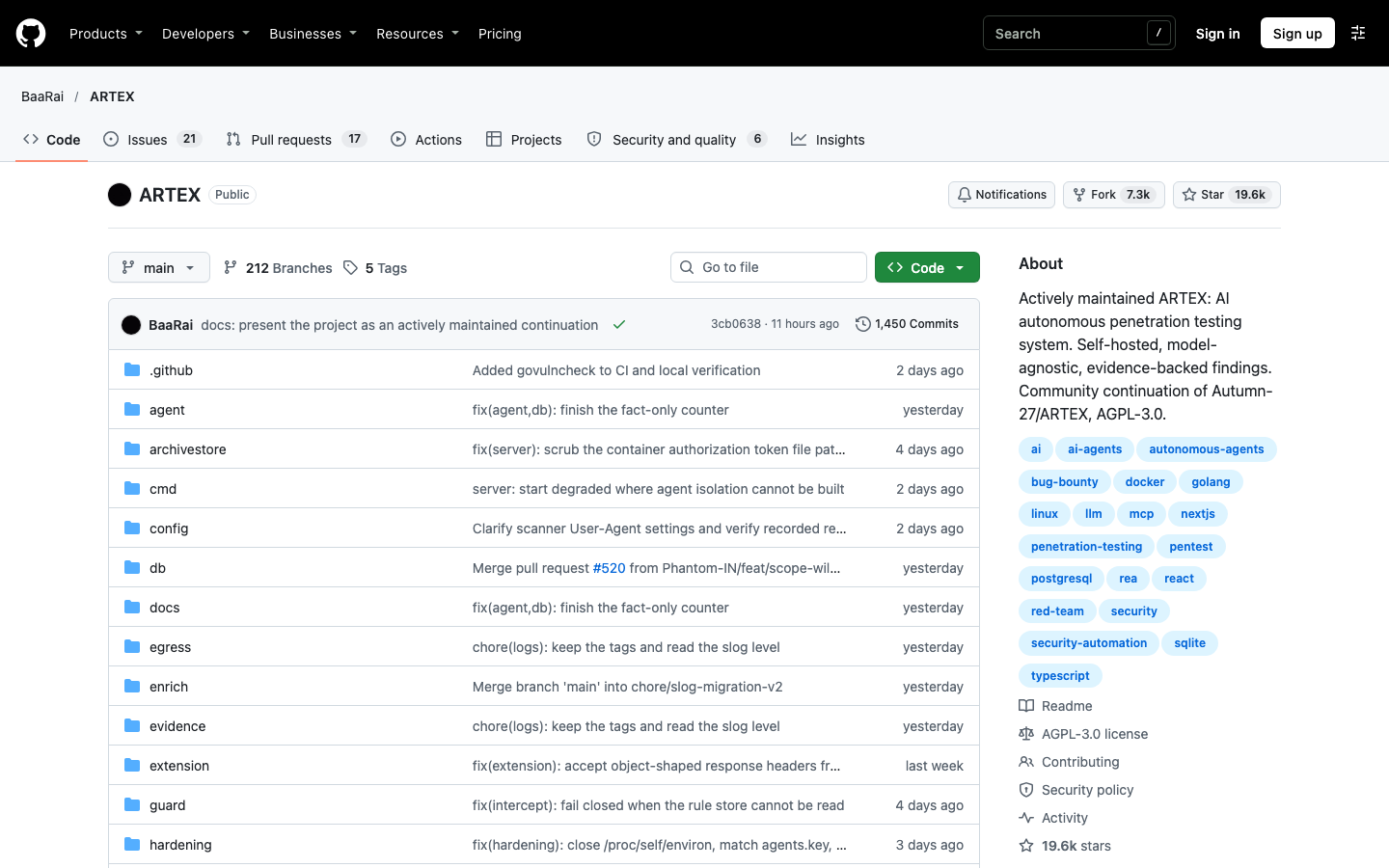
Real capture of github.com/BaaRai/ARTEX on November 25, 2026. The star figures on this page change daily; the one in this article is dated.
PentAGI: full autonomy in a sandbox, and observed in the wild
PentAGI (the “Pentagon” of the list) has been around since January 2025, MIT licence, 34,980 stars on November 25, 2026 (GitHub API). Its website defines it as a “fully autonomous” system that plans and runs tests in an isolated sandbox, self-hosted. These are vendor claims with no published independent replication.
It is one of the two, along with CAIRN, that GTIG says it observed deployed in real operations, not merely experimented with. In October it released version 2.2, with more model providers and failover. It also declares telemetry every three hours by default and a commercial edition with no published prices.
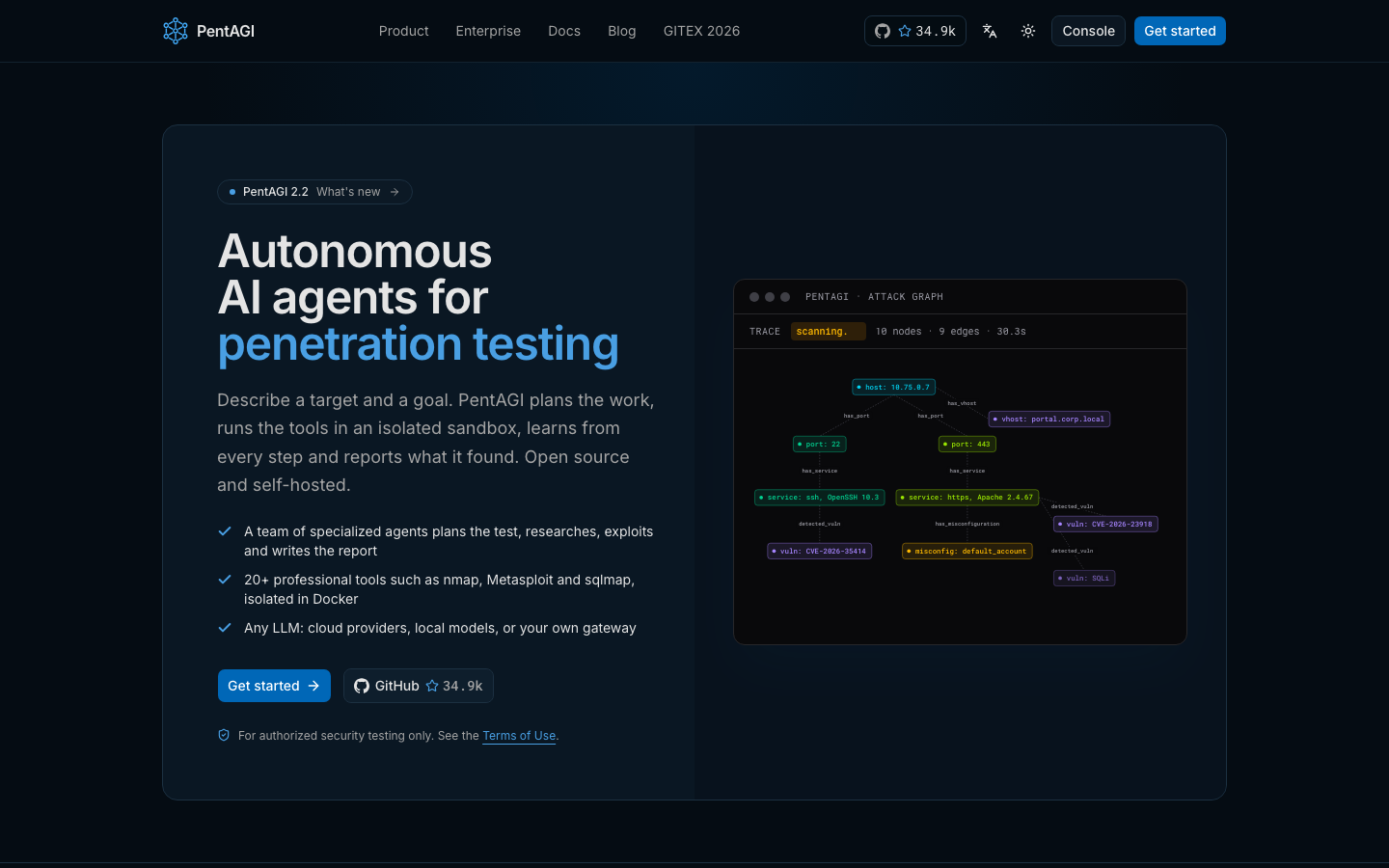
Real capture of pentagi.com on November 25, 2026. The “fully autonomous” description is vendor text.
HexStrike AI: the bridge to 150 tools
HexStrike AI is not an agent with a planner: it is an MCP server that connects Claude, GPT or Copilot to more than 150 pre-installed offensive tools (nmap, nuclei, sqlmap). MIT licence, 13,888 stars, latest version v6.0, officially packaged in Kali Linux since November 2025.
Its famous moment came earlier: on September 2, 2025 Check Point reported that, within hours of the disclosure of Citrix NetScaler CVE-2025-7775, CVE-2025-7776 and CVE-2025-8424, it saw forum chatter about using Hexstrike-AI to exploit vulnerable instances, with claims that the time dropped from days to under ten minutes. Read it precisely: Check Point reported unverified claims, not confirmed results, and named no attacker group.
Three nuances the comparison usually loses. The README publishes self-reported metrics (98.7% detection, 2.1% false positives) with no independent replication: these are vendor figures. GTIG places HexStrike in the “experimentation” group, not observed deployed in real operations. And a note on how claims travel: CACM wrote in June 2026 that Check Point had attributed the tool to the Storm-1575 group, an attribution absent from Check Point’s original text.
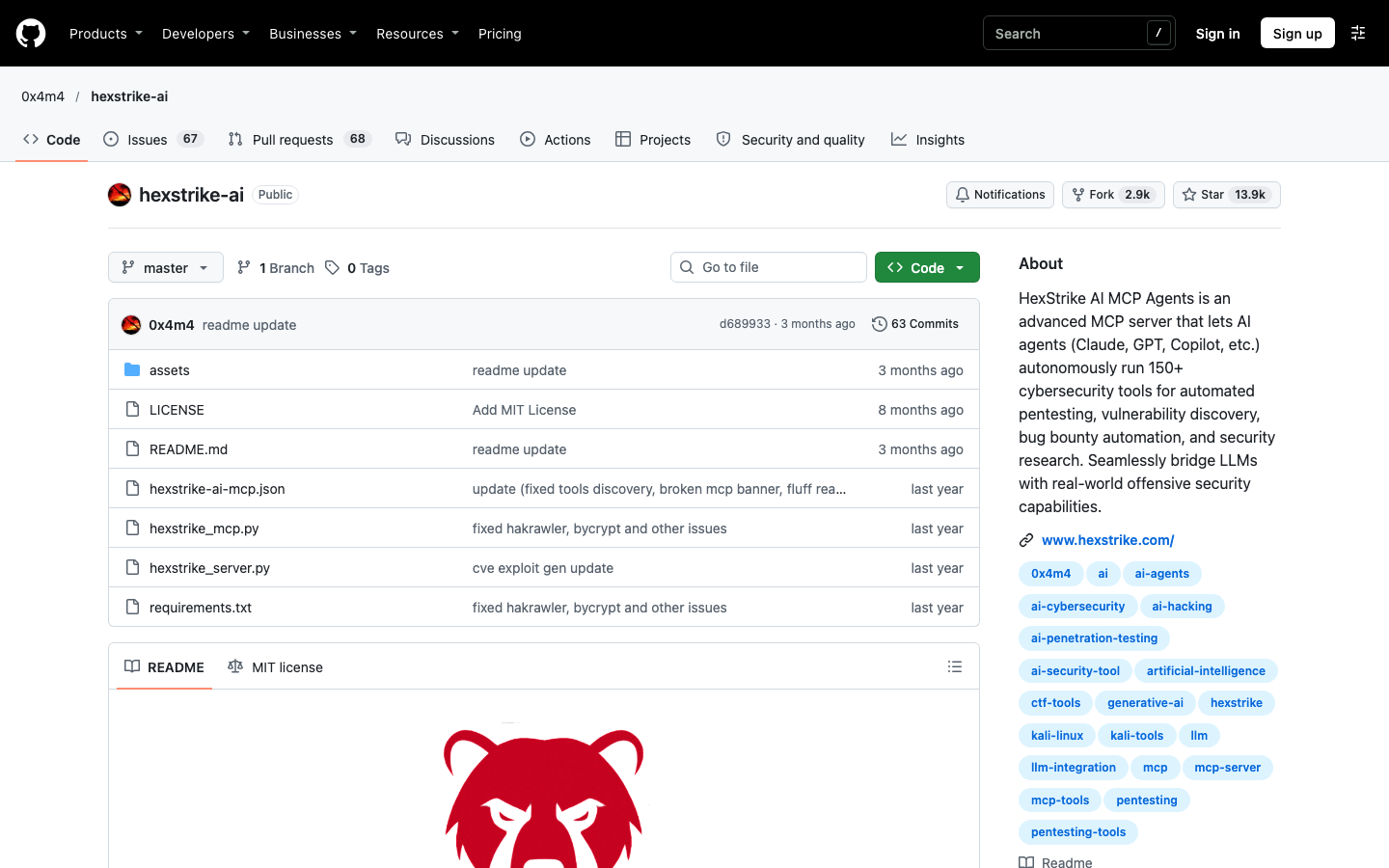
Real capture of github.com/0x4m4/hexstrike-ai on November 25, 2026, with the project’s branding kept.
CyberStrikeAI: a single console, bought by a threat-intelligence firm
CyberStrikeAI is an offensive operations console in Go, Apache-2.0 licence: agents, more than 100 tools in YAML recipes, MCP, a RAG knowledge base, human approvals, audit logging, a C2 and a Burp Suite integration. It measured 9,011 stars on November 25 (GitHub API).
Its 2026 path: in March, Team Cymru identified it on 21 IP addresses tied to the campaign against FortiGate devices that Amazon described on February 20 (600 devices in 55 countries; Amazon’s report does not name the tool, the attribution came later from Team Cymru). In September, ThreatBook announced its acquisition, keeping the open edition and announcing an on-premises enterprise edition; the figures in the release (7,000+ stars at acquisition, 3,000+ instances in use) are the vendor’s. In October, Trend Micro described an operation with 44 of its agents against at least 19 organizations, at least 16 of them in Japan: a single lab, no published replication.
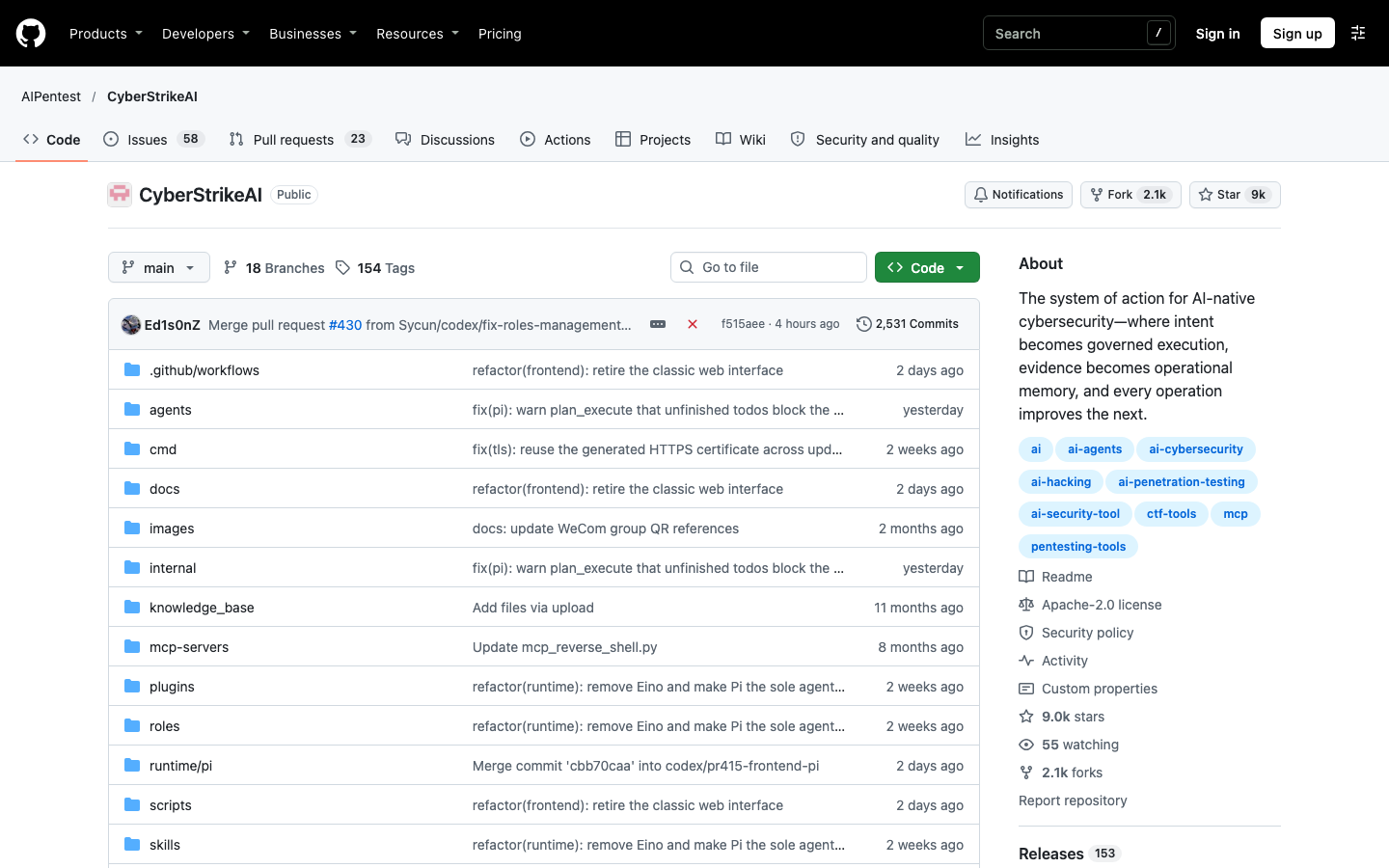
Real capture of github.com/AIPentest/CyberStrikeAI on November 25, 2026. Watch the namesake: there is also a different CyberStrike project (github.com/CyberStrikeus/CyberStrike) that is not this one.
CAIRN: a state-space search engine, not a tool collector
CAIRN (5,940 stars, AGPL-3.0 with a separate commercial licence, no website of its own) sells itself as “more than just AI pentesting”: a state-space search engine over a blackboard architecture with three primitives, confirmed facts, exploration intents and human hints. It delegates the work to existing coding agents inside Kali containers.
Elastic, reviewing the code, found that two of its three worker adapters start with approvals disabled, that workers are instructed never to reject a task, and that there are no default target restrictions. The README, for its part, claims 54 of 54 at a Tencent pentest challenge: a project figure, not replicated.
Its documented abuse is the most recent of the five. Amazon, on November 20, 2026, recounted that its agents found on their own a path traversal in MONAI Label (Amazon links that project’s advisory without naming it in the text) and exploited it in about 11 minutes (moderate-confidence attribution, from the logs of a single instance). Unit 42, on November 12, tracked 25 operations against at least 19 organizations between August and September, with unauthorized access or data retrieval at 10 of them. I covered the MONAI Label case right here three days ago.
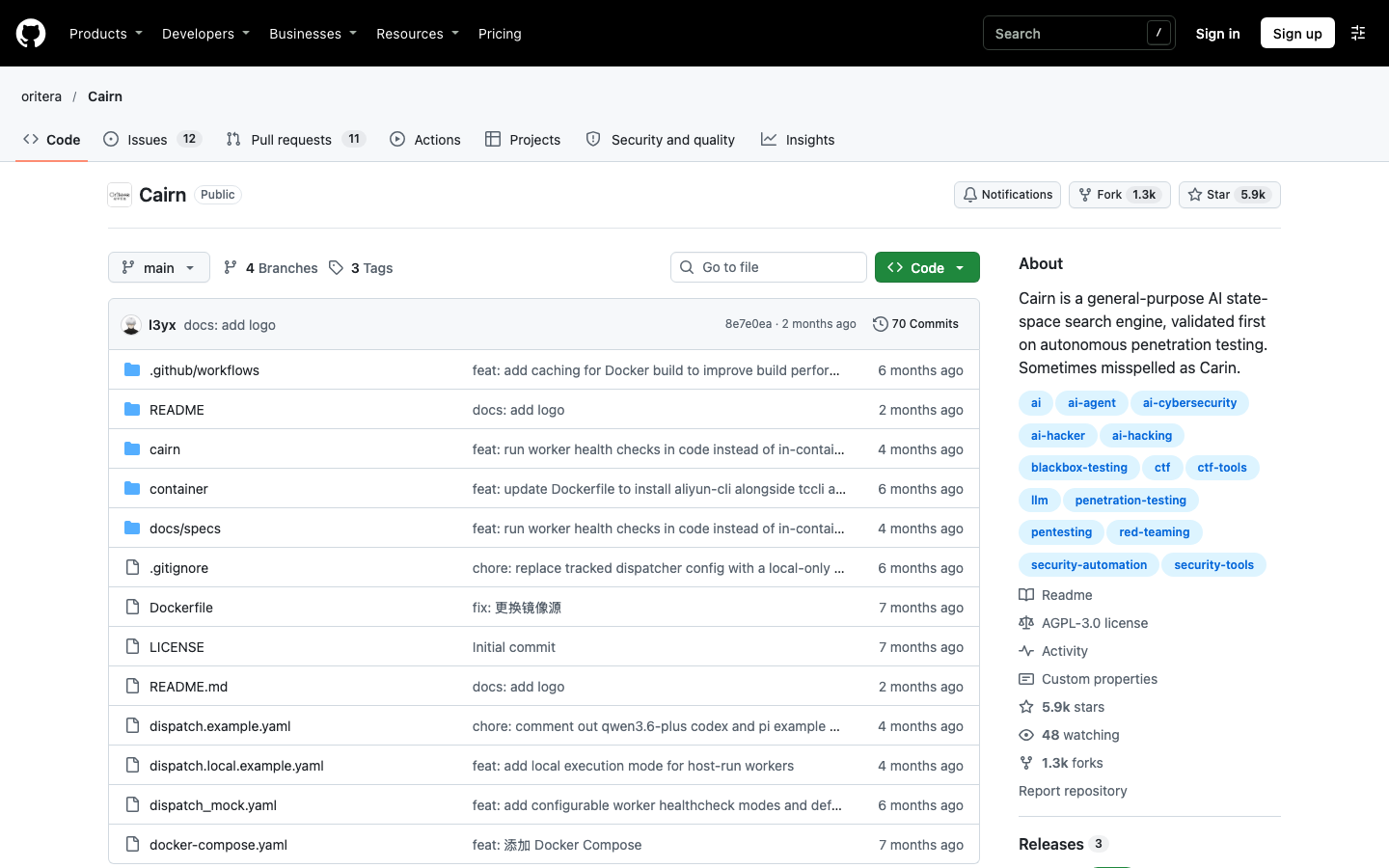
Real capture of github.com/oritera/Cairn on November 25, 2026. The star count changes daily.
The comparison, in a table
| ARTEX | PentAGI | HexStrike AI | CyberStrikeAI | CAIRN | |
|---|---|---|---|---|---|
| What it is | Platform with planner and workers | Autonomous system in sandbox | MCP server with 150+ tools | Operations console with agents | Search over a shared blackboard |
| Execution model | Graph of intents | Planning in sandbox | The model calls functions | YAML recipes and agents | Delegates to coding agents |
| Technical scope enforcement | Configurable rules only (CERT-EU) | Declared (vendor) | Depends on the LLM client | Approvals and allowlists | No default restrictions (Elastic) |
| Licence | AGPL-3.0 (fork) + paid console | MIT + enterprise edition | MIT | Apache-2.0 + enterprise edition | AGPL-3.0 + commercial licence |
| GTIG, Nov 16, 2026 | Observed in operations | Observed in operations | Experimentation | Experimentation | Observed in operations |
| Documented abuse | FBI, GTIG, Talos | GTIG (deployed) | Forum claims (Check Point) | Team Cymru, Trend Micro | Amazon, Unit 42 |
Own table from the sources cited in each section. The GTIG states are Google’s observations, not a quality or risk ranking.
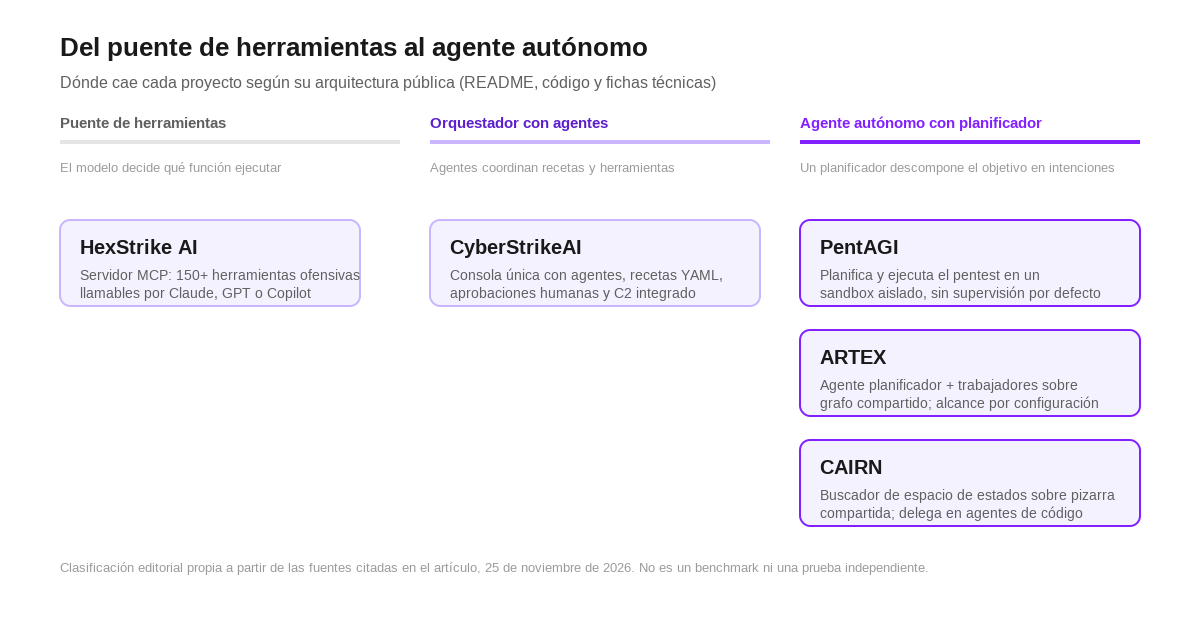
Own editorial classification, dated November 25, 2026, from READMEs and technical sheets. It is not a benchmark nor a test I ran.
The patterns that repeat across all five
First: scope is configuration, not code. CERT-EU says it plainly about ARTEX: no hard technical enforcement, only rules and the model’s judgment. Elastic finds the same in CAIRN, approvals disabled by default. In a pentest tool, scope is what separates an authorized test from a crime, and in all five it rests on a setting and the model’s judgment.
Second: none of them distinguishes a test from an attack. The same image serves both. Unit 42 found campaign prompts instructing the model to never refuse the task, and Amazon published that the objective written by the operator was only “obtain shell access”. The tool does not know whether a contract sits behind it.
Third: all of them are model-agnostic and bring your own keys. In the ARTEX instances inspected by Check Point, from a sample of 10 exposed databases, the only model that refused requests was Opus 5.5 and the operator switched to more permissive Chinese models. It is a small sample, but it points to where behavior is decided: in the chosen model provider, not in the tool.
Fourth: appearing in an intelligence report is not a quality score. GTIG distinguishes precisely between “observed deployed” (CAIRN, PentAGI) and “experimentation” (CyberStrikeAI, HexStrike), and experimenting is not failing. The reverse: that a project appears in no report does not make it safe, only invisible.
What these sources do not establish
- The READMEs’ performance metrics (98.7% detection on HexStrike, 54 of 54 on CAIRN) are vendor claims without independent replication.
- Amazon’s figures come from the logs of a single exposed instance and its attribution is moderate confidence.
- Trend Micro’s research on the 44 agents and Team Cymru’s on the 21 IPs each come from a single lab, with no third-party replication published.
- ThreatBook’s instance figures are the vendor’s own scanning.
- GitHub stars are dated November 25, 2026, and in ARTEX’s case they measure the fork, not the original repository, which was deleted.
- The GTIG states reflect what Google observed up to November 16, not a ranking between tools.
- The artex.lol console documents no relationship with the original ARTEX; comparing it to the removed project is an assumption.
If you are evaluating one of these
Before installing any of the five, what I would look at: is scope enforced technically or only by configuration? Are sandbox and approvals on by default or do you have to switch them on? What audit trail remains of each action? Which model provider do the data go to, and with which key? Does the licence permit commercial use (MIT and Apache-2.0 yes, AGPL-3.0 needs a review)? And is there a signed scope that says exactly what it may touch? At Plexicus we build agents that do this work with permission and a signed scope, and we apply those questions to our own tools first.
Main sources
- FBI/IC3, FLASH alert on ARTEX, Nov 13, 2026
- Google GTIG, AI Threat Tracker, Nov 16, 2026
- Elastic Security Labs, five agentic frameworks, Nov 13, 2026
- Amazon Threat Intelligence, Cairn’s zero-day (links the MONAI Label advisory), Nov 20, 2026
- Unit 42, CL-STA-1238, Nov 12, 2026
- Check Point, Hexstrike-AI and CVE-2025-7775, Sep 2, 2025
- CERT-EU, From Penetration Testing to Cyber Threat, Nov 5, 2026