VOLTA: When Malware Gives AI the Triage Job
The interesting question about AI in malware is often which job the model has been given.
Writing code, choosing a command and assessing stolen information require different evidence. Put them all under “AI malware” and it becomes harder to see what actually changed.
The model gets a sorting job
Talos’ October 31 analysis describes VOLTA-AUTODOXER, a Windows infostealer with an optional model stage. After collection, it can send structured victim data through OpenRouter for an assessment that prioritizes assets. Refusal handling can try another model; without an API key, the AI stage can be skipped. The analysis request occurs on the victim’s machine before the result is exfiltrated.
That is a consequential design choice even without a new vulnerability. The proposed automation sits where an operator would otherwise inspect a pile of records and decide what deserves attention.
I would separate two questions. Can a model produce a plausible assessment? Does that assessment reliably help an operator choose a valuable target? A convincing paragraph answers neither on its own. A retry path in a binary also does not establish that any provider accepted its request.
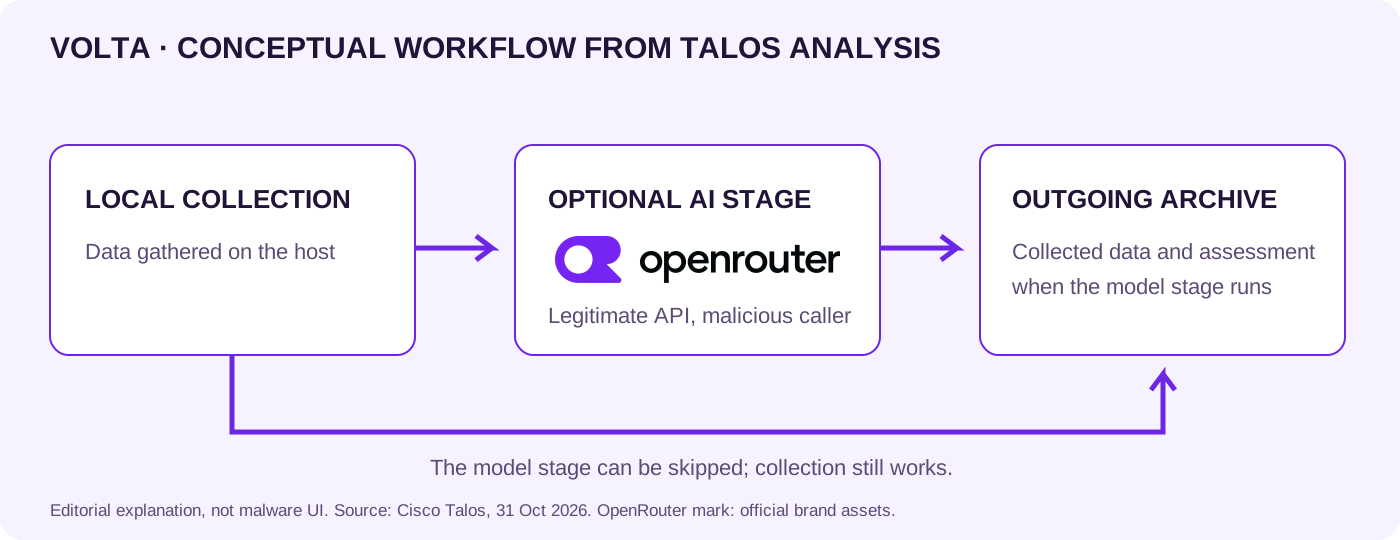
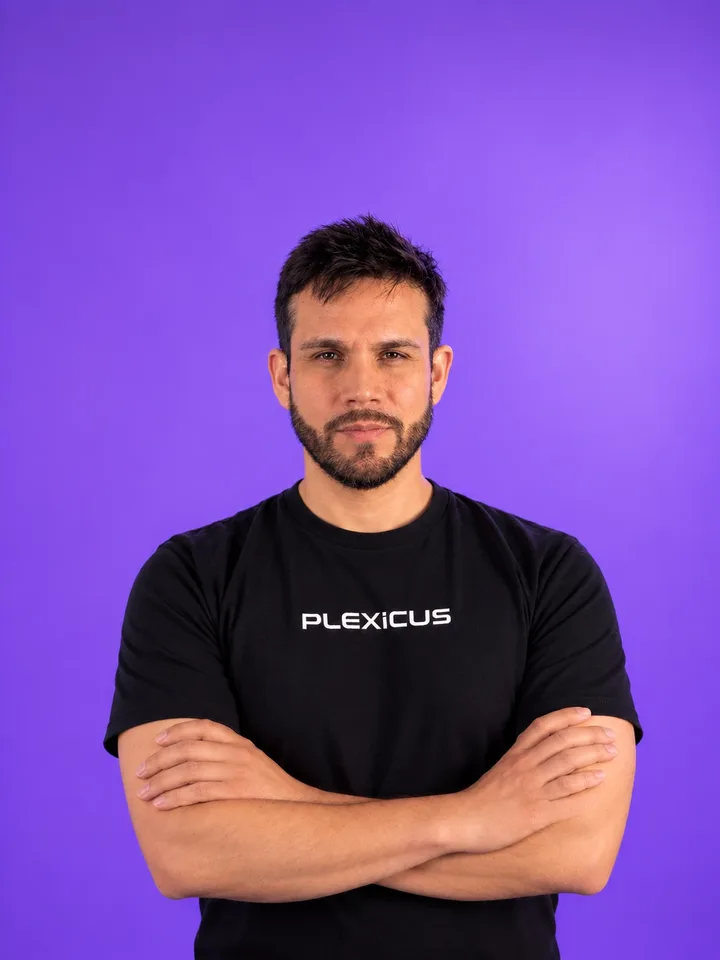
Original editorial diagram based on Talos’ analysis; not a capture from malware or a claim that OpenRouter was compromised. The original OpenRouter mark comes from its official brand assets.
A familiar API does not explain the caller
OpenRouter’s documentation presents a single API for accessing multiple models. That abstraction is useful to legitimate developers. In the workflow Talos describes, it also provides an ordinary service interface for a malicious caller.
The logo in this article identifies that legitimate service. It does not imply the provider created the malware or that its infrastructure was breached.
For defenders, I think the useful unit of investigation is the sequence: which process handled the data, what it could access, and why a request left the endpoint. A domain name can help locate activity. It cannot establish the intent of every program that contacts it.
This is also why a provider refusal and endpoint containment solve different parts of a problem. Preventing one assessment would not, by itself, establish that the earlier collection had been prevented.
Evidence of integration is not evidence of prevalence
WIRED’s interview with Talos researcher Ryan Fetterman says Talos did not track whether VOLTA had been used in the wild. I would not turn the sample analysis into a claim about the number of victims or successful attacks.
The CAIRN research introduction explains a metadata-first approach to finding AI-related artifacts such as prompts and provider references. It also warns that these clues generate noise and require validation. Finding an AI string in a file is a lead, not a complete account of what ran.
I find that distinction useful well beyond malware research. An integration can exist in source or in a binary without telling us how often a capability was exercised, whether it succeeded, or whether it improved an outcome.
| Question I would ask | Evidence that would help answer it |
|---|---|
| Was the AI stage invoked? | An observed request and its associated process context |
| Was the assessment useful? | Grounded evaluation against a manual baseline |
| Did it change the attack outcome? | A documented link between assessment and subsequent action |
| How common was it? | A defined observation window and defensible counting method |
These are evaluation questions, not claims that Talos observed those outcomes.
Keep response work tied to what was exposed
Talos recommends preserving the debug log if found, revoking potentially compromised tokens and changing passwords. Its report identifies the log as evidence of collection and model-call status.
The broader lesson I take from the design is to organize response around the exposed resources. “The AI request failed” would be a narrow result. It would not be a complete inventory of what happened to an account, a session or a file.
In my recent Lightpanda note, the engineering question was what work a purpose-built browser could remove. VOLTA poses an uglier version of that question: which sustained human task can an attacker delegate to a model?
That is worth examining carefully. It is also worth measuring before assigning it a scale or an effectiveness that the available evidence does not establish.
Sources
- Cisco Talos: Appraisal by AI — VOLTA analysis.
- Cisco Talos: Introducing CAIRN.
- OpenRouter: Quickstart.
- WIRED: Volta-Autodoxer reporting and researcher interview.
Follow jpalanco.com for more technical notes on AI, engineering and security research.