Robin and Open SWE: What Happens Between an Issue and a Pull Request?
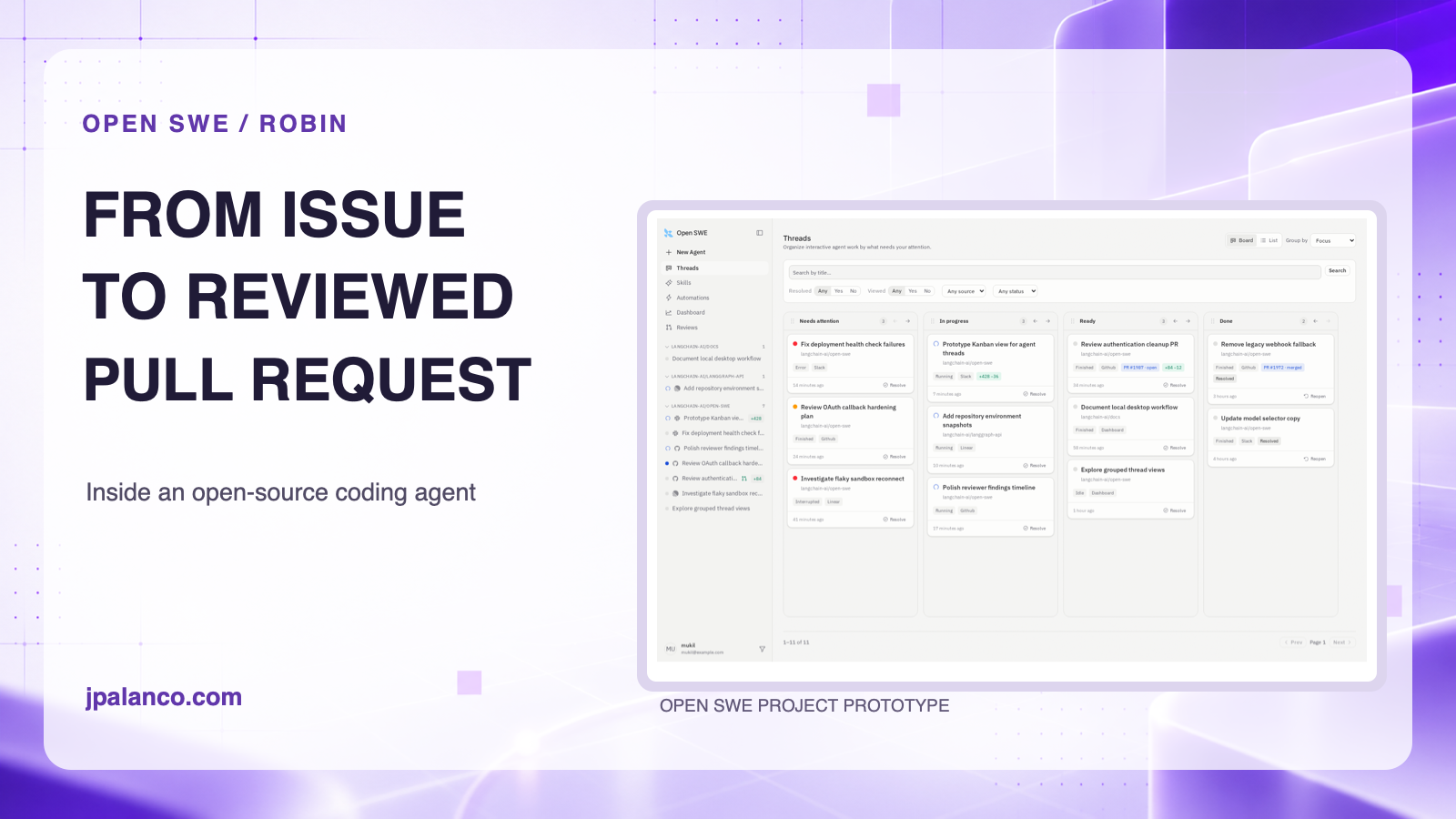
A coding agent that produces a plausible diff is interesting. An agent that can investigate a repository, work in an isolated environment, run checks and return a pull request is a much more consequential engineering system. Each step adds useful context—and a new boundary to understand.
LangChain’s open-swe repository, currently presented as Robin, offers a useful way to examine that shift. It describes an open-source software factory built on Deep Agents. The name and implementation are evolving: the repository warns that the project is under active development, may change incompatibly, and does not currently accept external issues or contributions. This is a look at its documented design, not a claim that it is production-ready for every team.
The real unit of work is the whole loop
Robin’s README describes a loop: work arrives from issues, conversations, pull requests or schedules; the agent plans and investigates; it implements changes in a sandbox; then it validates and delivers a pull request. Review, CI and feedback can trigger follow-up work. The project also describes integrations with GitHub, Slack and Linear, configurable models and sandbox providers, and parallel subagents.
That sequence matters more than a benchmark screenshot. A code change has to fit the repository, its tests and the people who maintain it. A task that appears trivial in isolation can cross several files, dependencies and operational assumptions. A useful agent needs enough context to find those edges and enough discipline to show its work.
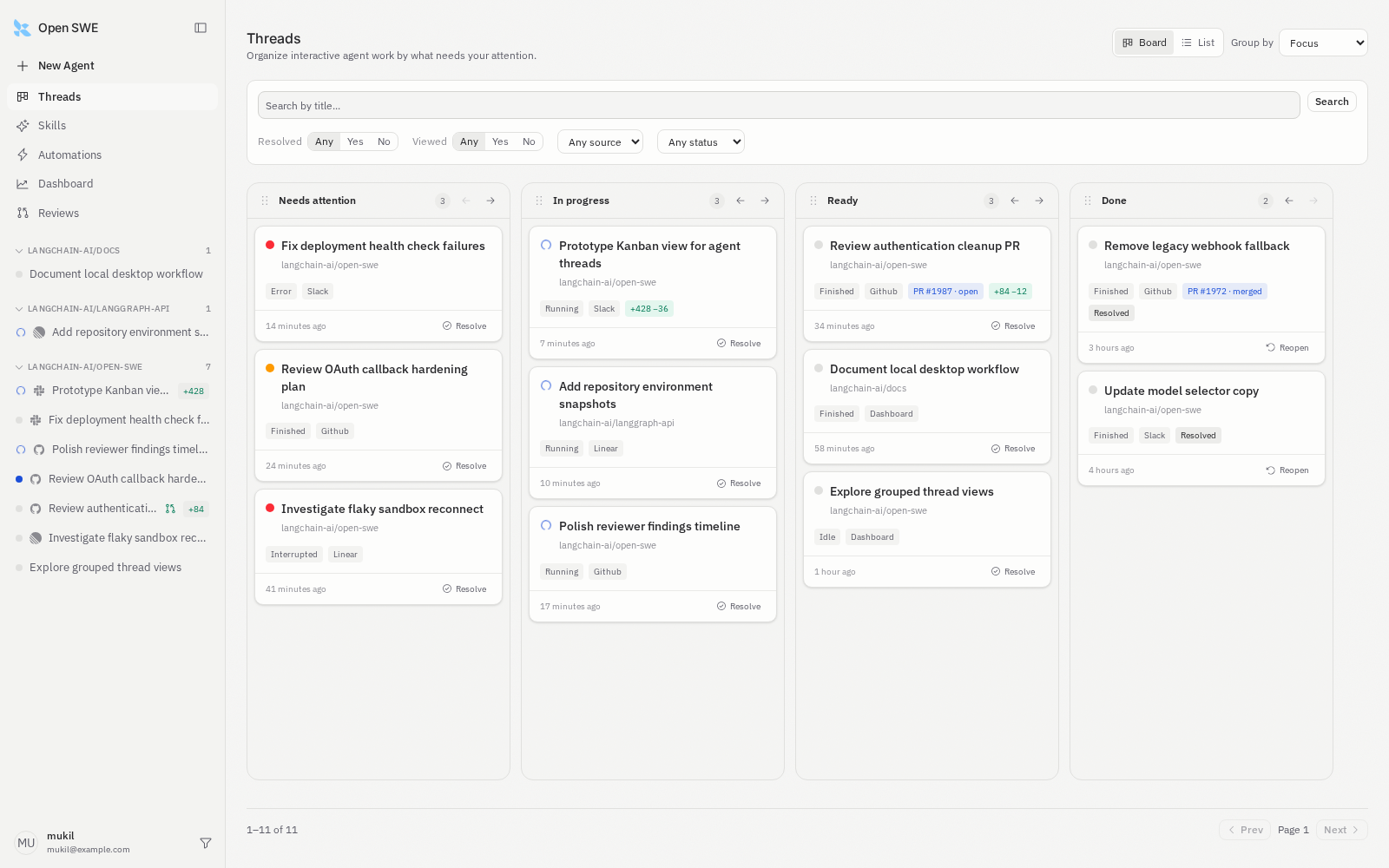
Original project prototype from the pinned repository snapshot, not a promise of the current deployed interface. Copyright LangChain, MIT license.
A sandbox is a boundary, not a magic shield
The documented cloud coding setup uses persistent Linux sandboxes scoped to a thread. Follow-up work can reuse that environment; the project says an unreachable coding sandbox is not silently replaced. Local execution is configurable, but the README explicitly says it does not provide cloud sandbox isolation.
Isolation helps separate execution environments, but it does not answer every authorization question. Robin’s documentation says coding sandboxes normally receive installation-wide GitHub App access; repository bindings control routing and preloaded checkouts, not a separate credential boundary. An operator should therefore examine the actual GitHub App installation, repository access, network access and integration credentials before allowing an agent to act.
Approval needs a precise meaning
The README says workflow-file approval prompts guard detected Git pushes, not every possible shell or API write. That detail is easy to miss and important to understand. A prompt at one point in a workflow is not evidence that all possible changes require the same approval.
For a real deployment, I would define which repositories an agent can access, which secrets it receives, where it can send data, and which actions need a human decision. I would also preserve logs and make failure states visible. Those are deployment choices to verify, not guarantees conferred by an agent framework.
A pull request is a handoff
The interesting artifact is not just the diff. It is the explanation of the problem, the checks actually run, any failures or uncertainty, and the context a reviewer needs to decide. The project describes review and CI monitoring features, but an agent-authored review or a green check should not automatically substitute for an accountable human review where the change requires one.
Treat automated validation as evidence with scope. A passing unit test says something useful about the cases it covers; it does not prove an integration works in production or that a credential boundary is sound. Make that distinction visible in the pull request.
Before trying it
Read the pinned README, installation guide and workspace access documentation. The project notes that deploying it as-is requires Managed Deep Agents; otherwise, it recommends forking and adapting the code to another runtime. Start with a low-risk repository, narrow access, a disposable test environment and a human-reviewed pull request.
The broader lesson is simple: the next step for coding agents is not merely writing more code. It is making the path from request to reviewed change observable, constrained and understandable.
For another perspective on the permissions an agent accumulates, read Hermes Agent: When Skills Need a Lock.