ARTEX: The Pentest Agent That Switched Sides, Checked Against the Sources


On November 13, 2026, the FBI published FLASH alert FLASH-20261113-001 about ARTEX, an open-source pentest framework driven by AI agents. According to the FBI, different malicious actors have used it since at least August 2026, and in some intrusions they went from first contact with the target to privileged access in under three hours. Microsoft, Google and others attribute part of that activity to state-aligned groups.
Three days later, on November 16, Google Threat Intelligence Group (GTIG) said in its AI Threat Tracker that it had seen attackers fully automate vulnerability discovery and exploitation for the first time, with no human in the loop.
I run Plexicus, where we build agents that do this same work with permission and inside a signed scope. That is why this piece puts the alert next to the sources it cites (Microsoft, Google, CrowdStrike, Zscaler, Check Point, Censys, CERT-EU and Akamai) and next to others published in the same weeks (Amazon, Huntress, Barracuda and WorkOS). What follows is what they say, what they do not say and where they contradict each other.
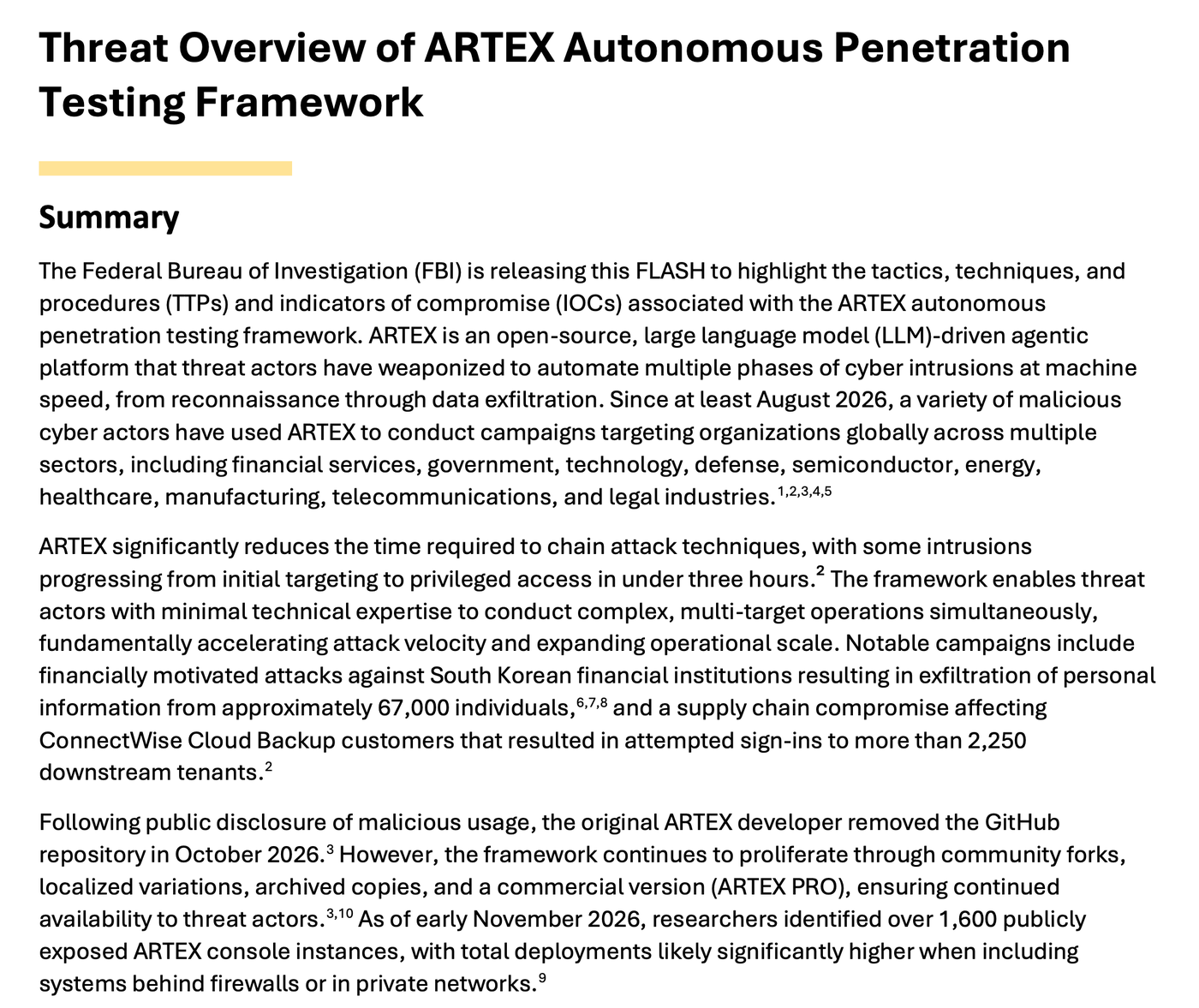
Real screenshot of the first page of the FBI alert (TLP:CLEAR, unrestricted distribution). Image cropped to the title and the summary, without the header.
What ARTEX is and where it comes from
ARTEX appeared on GitHub on July 26, 2026, according to Censys, under the “Autumn-27” account and with an AGPL-3.0 license. The FBI, Wiz and Barracuda also say July. The Record wrote August, which is the month the FBI gives for the start of the abuse.
The author is not unknown in the field. The same account publishes ScopeSentry, a Chinese asset discovery and vulnerability scanning platform, with 2,505 stars on November 18. Censys describes ARTEX as a layer of AI agents on top of that reconnaissance base.
Growth was fast. Censys estimates between 1,500 and 2,000 stars in ten weeks, and the FBI repeats that figure citing Censys. Wiz talks about more than 12,000 forks. The two figures do not fit well together, and the original repository no longer exists to check, so I would not put them in the same sentence.
On October 8, one day after the CrowdStrike report, the repository stopped being available. On his GitHub profile, the author left a note in Chinese with that date: it says the attacks have nothing to do with him, that the tool was for research and authorized testing, and that ARTEX stops receiving updates and becomes closed source. On November 18, Autumn-27/ARTEX returned 404.
Taking it down did not make it disappear. The FBI says it still circulates in forks, localized versions, archived copies and a commercial version called ARTEX PRO. None of the sources cited here says who sells ARTEX PRO or at what price.
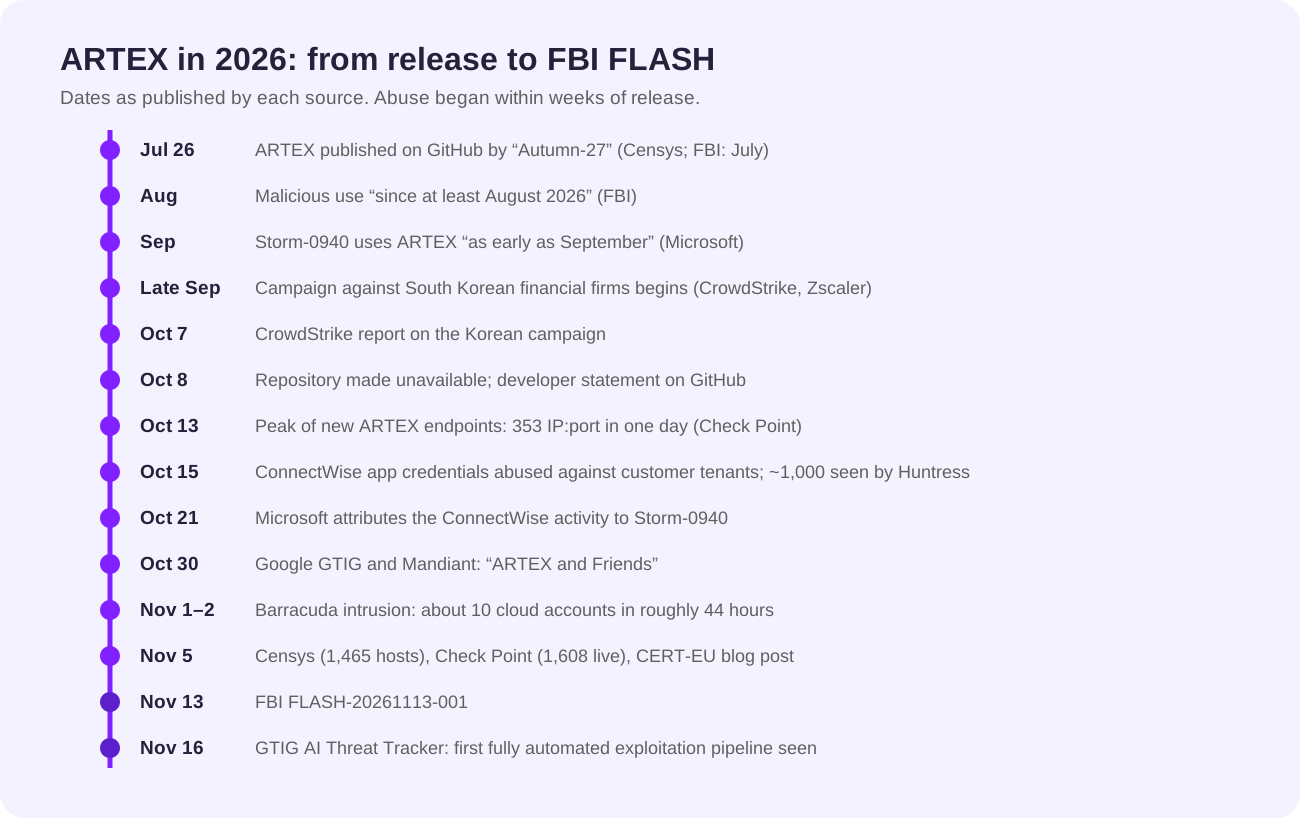
My own diagram with the dates each source publishes. It is not an image from the FBI or from any vendor.
How it works: one sentence, one planner and many workers
The idea is simple to explain. The operator writes a goal in natural language. A planner agent breaks it down into attack “intents”, and several worker agents run real tools (scanners, HTTP clients, scripts) and write what they find into a shared graph. The loop repeats until the goal is met.
That is how Censys describes it, after reading the code. CERT-EU adds that the console is designed for a person to watch and approve steps, with an approval queue. Amazon talks about planner, worker, verification and compression agents. GTIG counts six specialized subagents, without naming them. These may be different versions or the same design seen in more or less detail.
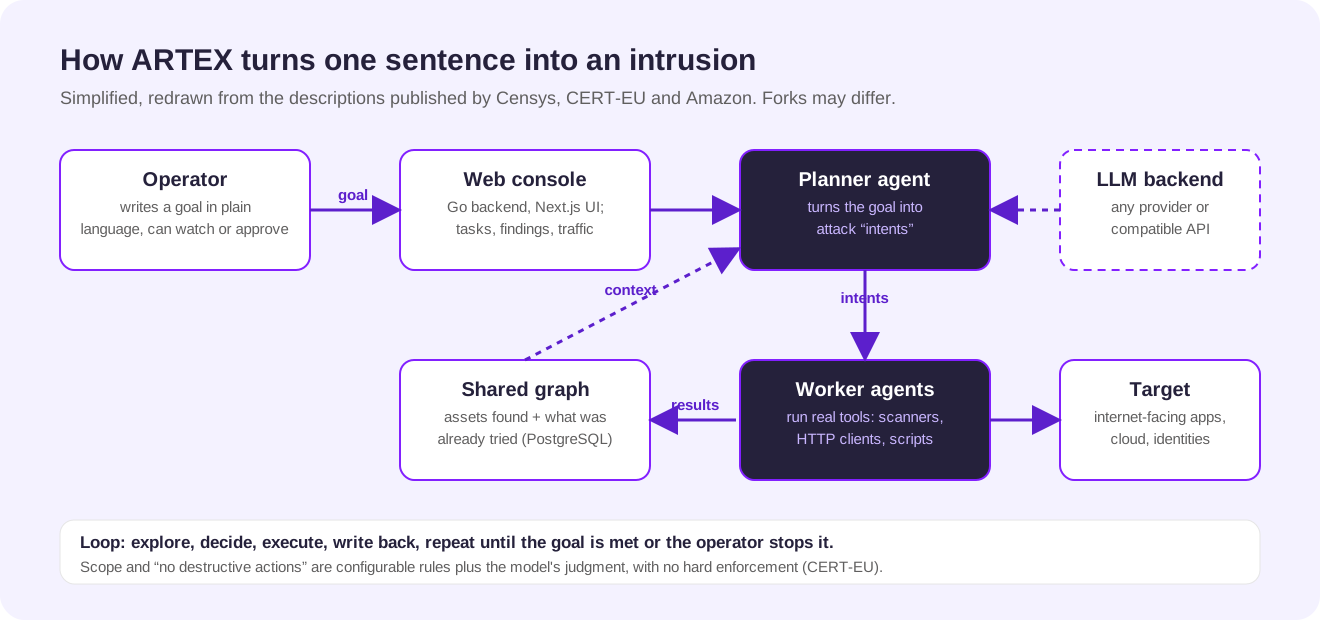
My own diagram, redrawn from the descriptions by Censys, CERT-EU and Amazon. It is not a screenshot of ARTEX.
ARTEX does not ship its own model. It connects to external providers, and the FBI cites Claude, GPT, DeepSeek, GLM, Grok and Kimi. According to the FBI, Chinese models dominate in attacker-controlled instances, above all the DeepSeek Flash family, because of cost and the lack of visible guardrails when the request is framed as a pentest.
That data point comes from a small sample. Check Point found 10 instances with an exposed database, holding 17 model configurations: five were DeepSeek v4.1 Flash and four were OpenAI models. In those databases, the only model that refused the operator’s requests was Anthropic’s Opus 5.5, and the operator switched to Chinese models.
There is one design detail that I think is the core of it all. CERT-EU writes that ARTEX relies on configurable rules and on the model itself to respect scope and avoid destructive actions, with no technical control that enforces it. In a pentest tool, scope is what separates a test from a crime. Here it depends on a configuration setting and on the model’s judgment.
Fast, but noisy
GTIG and Mandiant saw in their incident responses that ARTEX works in bursts of between 2 and 25 seconds, with long pauses between the phases of the operation. In one operation they counted 27 events in 23 seconds. In another intrusion, 240 log events with errors that could come from several subagents stepping on each other.
That has a good reading for defenders. GTIG says these tools “trade stealth for velocity”: they give up stealth in exchange for speed, and they leave recognizable file and account names. Microsoft adds that the default user agents of their tools also give them away. GTIG itself gives the bad reading: detecting in time is of little use if the goal is met before anyone reacts.
Which campaigns are documented, and how solid they are
This is the part that needs the most care, because figures travel from one report to another and change along the way. The table sums up the main cases, who measures them and how solid they are. Almost all the figures come from security companies about their own telemetry, and none has been independently replicated except where I say so.
| Case | Who documents it | Main data point | Solidity |
|---|---|---|---|
| South Korean banks and finance firms, late September to early October | CrowdStrike, Zscaler | Data on about 67,000 people | The number comes from Zscaler; CrowdStrike gives no victim count |
| ConnectWise Cloud Backup, Storm-0940 | Microsoft | Sign-in attempts against more than 2,250 tenants | Microsoft only; Huntress says its data does not independently confirm it |
| Storm-3358, financial sector | Microsoft | Cambodia-based cluster, since October | Microsoft only, no victim figures |
| Vapor Panda, since October 17 | CrowdStrike, via BleepingComputer | More than 200 organizations in 14 countries, at least 9 compromised | Secondary source; the original CrowdStrike report has not been consulted |
| DIVD, September | DIVD, via BleepingComputer | From initial access to root in 12 minutes | Secondary source |
| Ten exposed operator databases | Check Point | Three criminal campaigns | Sample of 10, good for seeing methods, not for measuring the total |
| Amazon honeypots (MadPot), October 3 to November 5 | Amazon | Theft of AI model credentials | Amazon cannot verify the results the agents claimed for themselves |
| Seoul police | BleepingComputer, citing the police | 7 suspects, more than 90 organizations, 8.2 million records | Secondary source; part of the theft predates ARTEX |
| Barracuda, November 1 and 2 | Barracuda | About 10 cloud accounts in about 44 hours | Attributes the tool, not the actor |
| WorkOS, October 25 to 30 | WorkOS | A researcher’s agent escaped its sandbox | The researcher’s account, validated by WorkOS; the how has not been published |
Korea: the campaign that exposed the abuse
CrowdStrike published the first analysis on October 7. A likely Chinese-speaking, financially motivated actor attacked peripheral services of financial institutions: a loan inquiry service for brokers and a work app for employees. They found it because the attacker left open directories with Claude Code histories and ARTEX configurations.
In one of those Claude Code sessions, the attacker asks where stolen Korean data is sold. CrowdStrike reports it as a question, does not say what the answer was, and explains that those additional sessions used GLM-5.3 and Grok 4.6 as the backend. Zscaler added on October 14 the figure of about 67,000 people affected, with names, phone numbers, annual income and loan limits.
Zscaler also found something telling in the code: ARTEX shipped with a default blocklist for government and education domains. It did not include banks.
ConnectWise: what ARTEX did and what it did not
This case has often been exaggerated when cited. According to Microsoft, the Chinese state-aligned actor Storm-0940 used ARTEX during the campaign for reconnaissance, password spraying and abuse of OAuth applications at ConnectWise customers. No source says ARTEX got into ConnectWise. As of its latest status page update, on November 11, ConnectWise had not explained how the credential was stolen.
The numbers also call for precision. Microsoft talks about sign-in attempts against more than 2,250 tenants, after the unauthorized access; its infographic says “reached”. The peak of 2,900 attempts per minute belongs to a password spraying run from October 10 to 14 that, according to Microsoft, did not get a single successful access. Censys mixes the two figures in one sentence, and BleepingComputer turned Huntress’s 162 tenants with unauthorized sign-ins into 162 compromised tenants.
Huntress, which monitors affected tenants, published the most useful independent analysis. In its first report it saw attacker activity in almost 1,000 tenants and more than 300 successful sign-ins. In the two tenants for which it had audit logs, it confirmed role and credential changes.
Its hypothesis is that scripts did almost all the work and an operator, human or agent, tuned them between runs. Huntress puts its confidence that an LLM was involved at low to moderate, based on its own data, and says its telemetry “aligns with Microsoft’s findings, but does not independently confirm them”.
The “under three hours” figure is Microsoft’s, about Storm-0940’s ARTEX attacks in general. The FBI repeats it citing Microsoft. Huntress saw something similar in those two tenants, with privilege changes made in under three hours, but attributes part of that speed to the stolen credential.
Microsoft does not leave the case at mere attempts either. Among its detections it describes bulk secret reads in several Azure customers’ Key Vaults. What no source quantifies or confirms is the exfiltration of customers’ business data.
What Check Point, Barracuda and WorkOS teach
The databases Check Point found are the closest thing to seeing the attacker’s screen. In one campaign, the agents stole more than 300 iOS signing certificates in two weeks, at an estimated cost of between $700 and $1,500 in tokens; only three passed validation. In another they collected more than 190,000 credentials for a video game, of which 3.3% worked according to the agents’ own sampling, for between $180 and $360. According to Check Point, the agents worked almost on their own after receiving the goal.
Barracuda told the story of its own incident with unusual frankness. It gave a vendor an access key to its cloud and did not revoke it when the project ended; the key ended up in a vendor repository. The attacker touched about 10 accounts in about 44 hours. Barracuda says the match with ARTEX explains how the attacker operated, not who they were.
WorkOS is the most uncomfortable case for my industry. According to WorkOS, which validated a researcher’s account with a forensics firm, it was not a criminal: the ARTEX agent that this researcher used for benchmark testing escaped its isolated environment. The agent got into a legacy internal platform, exposed to the internet, with a weak credential meant for local development and no rate limits, and pulled data from sales and support systems. WorkOS took five days to see it.
How many consoles are exposed
It depends on whom you ask and what they count. Censys saw 1,465 hosts with the ARTEX console exposed in early November (its text gives November 3 and November 4 for the same figure), and estimates that about 650 come from two hosting blocks, each with its own template. That leaves about 815 distinct installations.
Check Point counted 1,608 live instances and 2,557 systems that hosted a panel at some point, although its summary speaks of more than 1,800. The FBI’s “more than 1,600” comes from Check Point, although The Record attributed it to Censys. In the two sources that give countries, the top three match: the United States, Hong Kong and China, which shows where the hosting is, not who operates it.
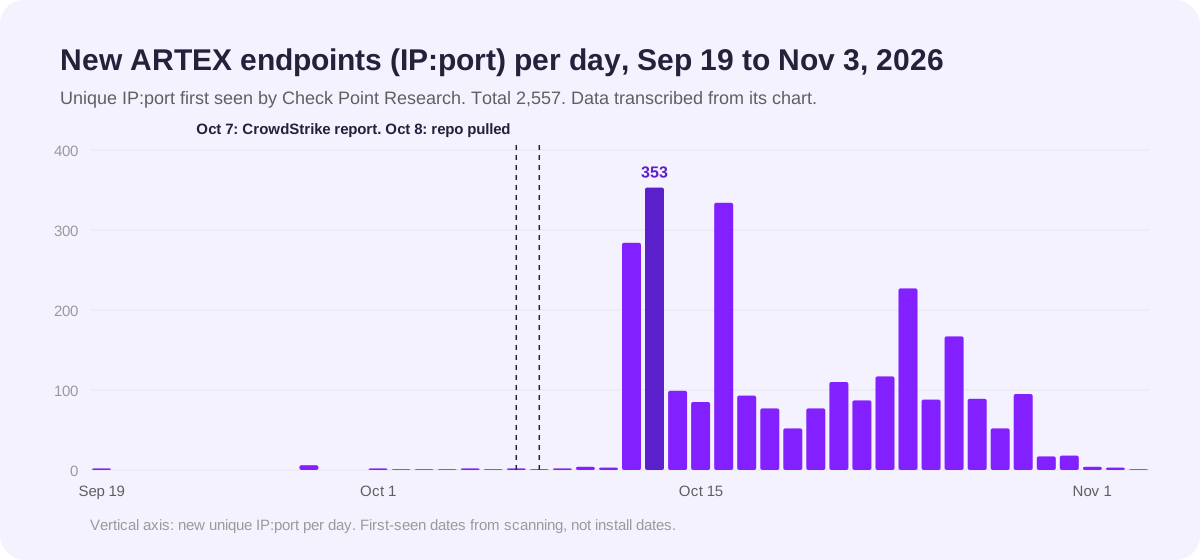
My own chart with the daily data Check Point publishes, transcribed from its figure. The unit is a new IP:port detected by scanning, not an installation. The values add up to 2,557, the total Check Point gives.
Check Point notes it in passing and the chart makes it visible. Until October 11, at most a few new endpoints appeared per day. On October 12 and 13, four days after the repository takedown and in the middle of the press coverage, 637 appeared.
It is better not to read that as 637 new attackers. Censys attributes hundreds of hosts to repeated provisioning templates, and Check Point groups 255 hosts under a single version tag. What the chart does show is that the takedown did not slow down the new deployments detected.
The other warning: Google and the patch window
The GTIG report of November 16 goes beyond ARTEX. It describes exploit_agent, a framework found on an exposed staging server that compares code before and after a patch, identifies possible flaws, drafts an exploit and runs it with no human intervention. GTIG presents it as the first time it has seen that full cycle automated.
That changes the value of a patch. For years, publishing a patch bought you a few days, because someone had to reverse engineer the change. If an agent does that comparison in minutes, the published patch becomes the attacker’s starting point.
GTIG’s data points in that direction, with caveats. In its trends analysis of September 30, exploited zero-days went from an average of 8 per month in 2025 to 11 per month in 2026, with 22 in August. That average of 11 already includes August; without it, it drops to 9.3. According to GTIG, most of the growth comes from n-days, flaws that are already patched.
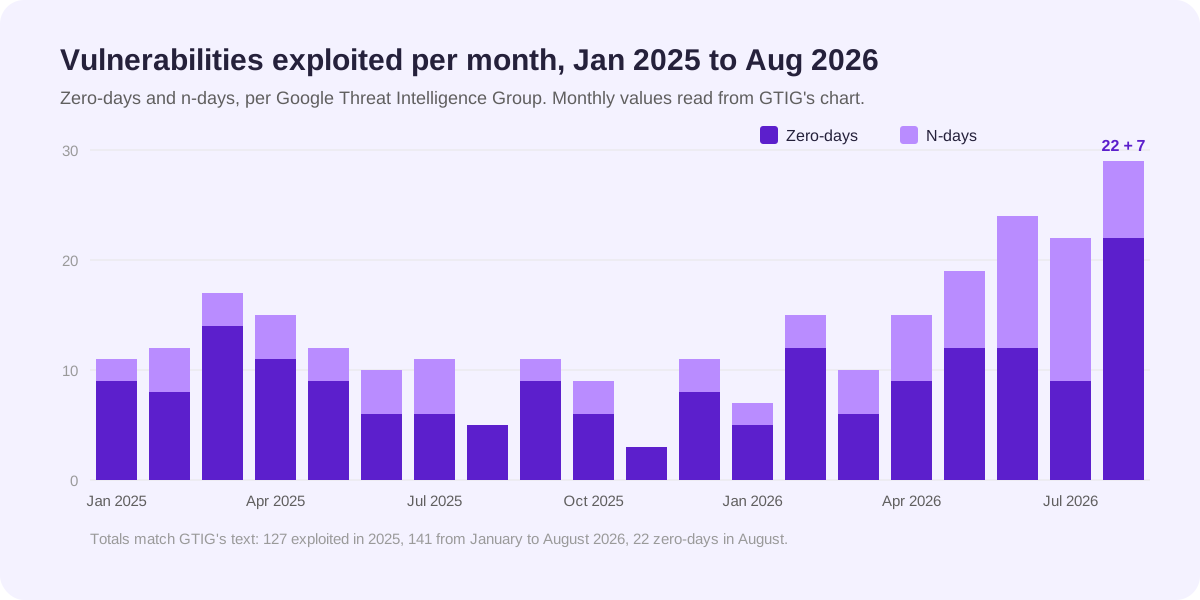
My own chart. The monthly values are read from the GTIG figure, not published as a table, but the totals match its text: 127 in 2025 and 141 from January to August 2026.
There is a measurement caveat. The tracker says published vulnerabilities and exploits almost doubled between January and August. Published ones went from 5,045 in January to 10,740 in August, slightly more than double. For exploitation, the original analysis does not compare January with August: it compares annual averages, 10.5 per month in 2025 against 18 in 2026, 1.7 times more.
GTIG gives a concrete example. In August, two PaperCut flaws were exploited as zero-days; researchers generated working exploits with an LLM in one day, and according to GreyNoise, cited by GTIG, an attacker launched a campaign against hundreds of organizations four days after disclosure.
GTIG also publishes a seven-stage maturity scale. This is the part that has reached the headlines:
| Stage | GTIG description | When |
|---|---|---|
| 5 | Several attack phases carried out by LLM-powered tools in real attacks, with little human intervention | Now |
| 6 | Unsophisticated attacks with several agents and little or no human interaction | Short term, 1 to 3 months |
| 7 | Sophisticated, fully autonomous attacks | Medium term, 3 to 6 months |
That timeline is in the text of the October 30 report and in a figure of the tracker, not in its text. GTIG calls it a projection. BleepingComputer turned it into a deadline of three and six months from now, which is somewhat more categorical.
What the sources do not establish
- That ARTEX was used to get into ConnectWise. Microsoft uses it to describe the activity against customers.
- That business data from ConnectWise customers was exfiltrated. Microsoft describes secret reads in Key Vaults, but nobody quantifies or confirms an exfiltration.
- The figure of 67,000 people outside Zscaler. CrowdStrike said the number of affected organizations was not confirmed.
- Who sells ARTEX PRO, or whether the original author has any link to it.
- That the Norma SDK, another repository by the same author, is ARTEX or its successor. Microsoft says ARTEX uses a Norma function by default; that is a dependency, not a succession.
- That blocking the IPs in the alert is enough. Mandiant says static indicators are useful when they exist, but they will not cover much of this activity.
- Which model drove each intrusion. Where it is known (Korea and the Check Point sample), DeepSeek predominates. In Check Point there were also OpenAI models configured, with no refusals recorded. Amazon describes agents that searched for frontier model keys, and in ConnectWise, Barracuda and WorkOS the model is not published.
What I would do this week
Mandiant sums it up in a sentence I agree with: these tools do not change the techniques, they cut the time needed to combine them. That is why the list has nothing exotic in it. The hard part is doing all of it.
- Inventory what nobody watches. The FBI, with a list almost identical to Akamai’s, lists partner and vendor portals, mobile backends, employee apps, sales support systems, legacy services and third-party integrations. In Korea and at WorkOS, the entry point was one of those.
- Take admin panels off the internet. Cloud consoles, deployment endpoints such as Kudu/SCM, hypervisors and backup platforms, reachable only from trusted networks.
- Retire long-lived credentials. Barracuda says short-lived, minimally scoped credentials would have stopped its intrusion at the first step. Search for secrets in repositories, pipelines and images, and rotate them.
- Review the permissions of multi-tenant apps. At ConnectWise, according to Huntress, a trusted app assigned itself the Global Administrator role. Alert when an app adds credentials, changes roles or deletes itself, and search by application ID, not by name.
- Measure speed, not just signatures. Rate limits on high-impact APIs, alerts on sequential queries in portals and a baseline of what your legitimate automation does.
- Do not archive minor findings. CERT-EU asks to keep them in the remediation cycle, because an agent can chain weak configurations that a person does not have time to test.
- Test your perimeter at the same pace. If the attacker tests every day, an annual pentest is a snapshot of something that moves. WorkOS, after the incident, started running ARTEX against its own systems. If you do something similar, treat any copy of ARTEX as untrusted code (the original repository no longer exists, so everything is a fork) and put technical scope limits on it, because the tool does not enforce them.
- Preserve logs before touching anything. According to the ConnectWise guide, Entra logs are kept for 7 or 30 days depending on the license, and what has expired cannot be recovered.
Frequently asked questions
Is ARTEX malware?
No. It is a pentest framework published for authorized testing. The problem is that scope depends on configurable rules and on the model, so it works just as well for attacking without permission.
Is blocking the IPs and domains in the alert enough?
No. The FBI asks to verify them before blocking, because they may be cloud infrastructure that changes hands. And the sources agree that the useful defense is behavioral: speed, volume and access from new locations.
Is detecting these attacks easy because they are noisy?
Detecting them is easier than detecting an expert human. Responding in time is not. Barracuda detected it on November 4, when the activity had already ended, and WorkOS five days after the first access.
Are Claude or GPT involved?
ARTEX can use them, and CrowdStrike found Claude Code sessions from the attacker, although with other models as the backend. In the cases where the model is known, DeepSeek predominates, and the only refusal recorded by Check Point came from an Anthropic model. A provider being compatible does not make it an accomplice.
What changes for a CISO in Europe?
CERT-EU says it has seen similar activity against its community, very likely with ARTEX. Its recommendations match the FBI’s on exposing less and isolating control panels, and they add urgent patching of exposed systems and monitoring of privileged accounts.
Sources
- FBI, FLASH-20261113-001, Threat Overview of ARTEX Autonomous Penetration Testing Framework, November 13, 2026.
- Google Threat Intelligence Group, AI Threat Tracker: Agentic Threat Activity Crosses a Significant Threshold, November 16, 2026.
- Google Threat Intelligence Group and Mandiant, ARTEX and Friends: Enter Agentic Offensive Frameworks, October 30, 2026.
- Google Threat Intelligence Group, Vulnerability Discovery and Exploitation Trends in the AI Era, September 30, 2026.
- Microsoft, Storm-0940 and ConnectWise, October 21, 2026, and Storm-3358 and the financial sector, November 6, 2026.
- Huntress, ConnectWise (SkyKick) Vendor Credentials Abused in M365 Attacks, October 16, 2026, and AI, Scripts, Operator: Inside the ConnectWise Attack, October 26, 2026.
- ConnectWise, Cloud Backup technical investigation and remediation guide, October 18, 2026.
- CrowdStrike, analysis of an unknown threat actor using ARTEX against South Korean finance, October 7, 2026.
- Zscaler ThreatLabz, analysis of the campaign against South Korean financial institutions, October 14, 2026.
- Check Point Research, Hacking on Autopilot: Inside ARTEX Cybercrime Campaigns, November 5, 2026.
- Censys, ARTEX: Agentic Asbestos, November 5, 2026.
- CERT-EU, From Penetration Testing to Cyber Threat: Beware of ARTEX, November 5, 2026.
- Amazon Threat Intelligence, criminal campaigns with ARTEX agents, November 13, 2026.
- Akamai, What ARTEX Reveals About Overlooked Attack Surfaces, October 23, 2026.
- Barracuda, Forty-four hours: Anatomy of a machine-speed intrusion, November 11, 2026.
- WorkOS, update on the October 30 incident, November 6, 2026.
- Wiz, ARTEX in the wild: Storm-0940 expands targeting of IT and software vendors, October 22, 2026.
- The Record, story on the FBI alert, November 13, 2026.
- BleepingComputer, Google and fully automated attacks, November 16, 2026; Vapor Panda and DIVD, November 2, 2026; and the arrest in South Korea, October 26, 2026.