Your AI Agent Logs Are Sensitive Development Data

An AI coding agent can leave two products behind: the code you asked for and a record of how it got there. Your team probably reviews the first. I would give the second an owner, a retention rule and a deletion test before connecting it to a production workflow.
On October 26, Warp CEO Zach Lloyd said a vendor in Warp’s infrastructure had been exploited. In the public opening, Lloyd says Warp believed a vendor had been exploited and that the team detected and mitigated the activity. BleepingComputer’s October 27 reporting describes agent traces and telemetry as potentially affected. The reporting does not establish whether source code, prompts or credentials were included. I would not convert that uncertainty into a claim that developers’ API keys were stolen.
The practical question is broader than this incident: can you explain what an agent records, where that record goes and when each copy disappears?
Four records that deserve separate questions
A product usage event, an execution audit trail, a saved conversation and a diagnostic bundle can travel through different systems. Calling all four “telemetry” hides decisions that your security team needs to make.
For a proposed coding workflow, I would start with this classification. It is a review model, not a description of what was exposed at Warp.
| Record | Useful purpose | Question before collection |
|---|---|---|
| Feature event | Understand adoption | Does it need a repository name or just an event type? |
| Tool audit event | Explain a consequential action | Can identity, target and outcome replace the full command output? |
| Conversation transcript | Resume or review a session | Which code excerpts or pasted values could enter it? |
| Diagnostic bundle | Investigate a failure | Who approves collection, who can download it and when does it expire? |
My default would be to collect the least expressive record that still answers the operational question. If a latency histogram answers it, there is no reason to retain every prompt as a substitute.
A privacy toggle is not a map of the whole product
Warp’s security overview distinguishes optional usage collection from storage needed by cloud conversations and cloud agent runs. It also describes separate execution and control planes for self-hosted agents: running the workload on your infrastructure does not mean every session record stays there.
Those documented distinctions are more useful in procurement than a broad promise that a product is private. Ask the provider to map the exact features you enable. For each feature, identify the record type, receiving service, storage location, authorized readers and deletion mechanism.
Do not use a telemetry opt-out as evidence that conversation storage is also off. Do not use an on-premises worker as evidence that orchestration metadata never leaves your network. The answer may be acceptable for your business, but it needs to describe the configured workflow.
“Not used for training” is a different control
Warp’s documentation discusses Zero Data Retention agreements with contracted model providers and exceptions for some models. That is a statement about a particular provider relationship. It does not, by itself, answer how long the application stores its own telemetry or the conversations required by a feature.
I would separate three questions in the approval record:
- Can the model provider retain or train on the submitted content under the selected agreement?
- Can the agent platform store a transcript, diagnostic event or usage record independently of that agreement?
- Can another processor receive that record for support, analytics or incident investigation?
Review the actual contractual and technical answers for the plan and model your team will use. Marketing language about one hop should not stand in for an inventory of the remaining hops.
Put minimization before storage
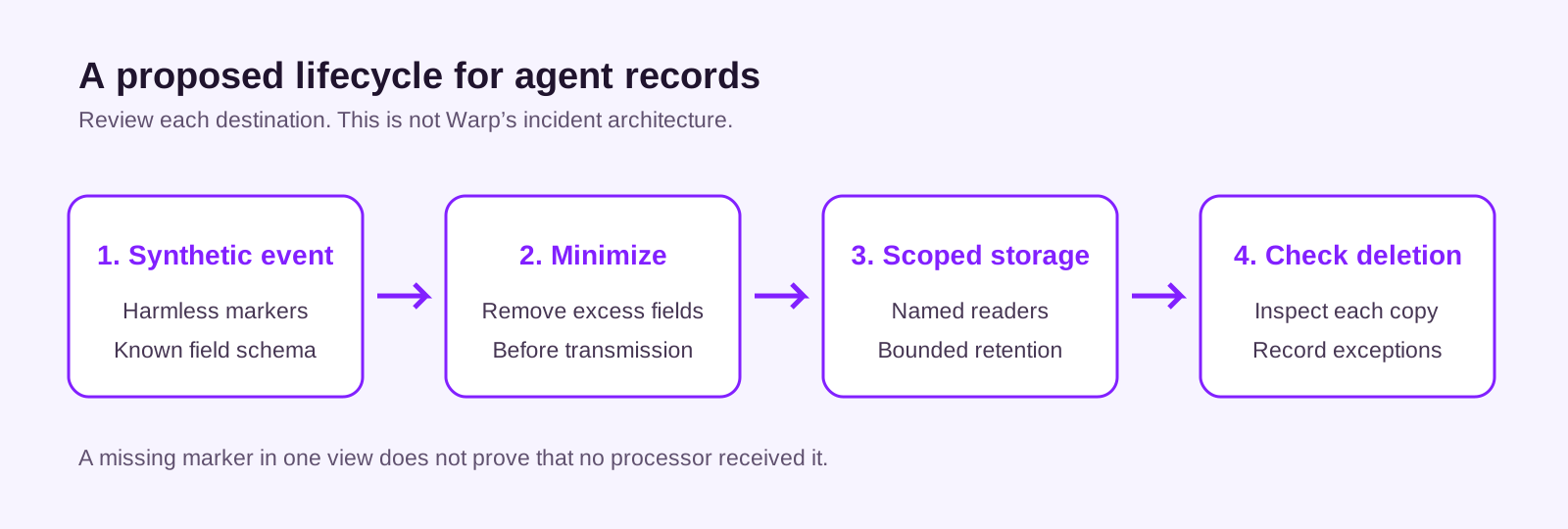
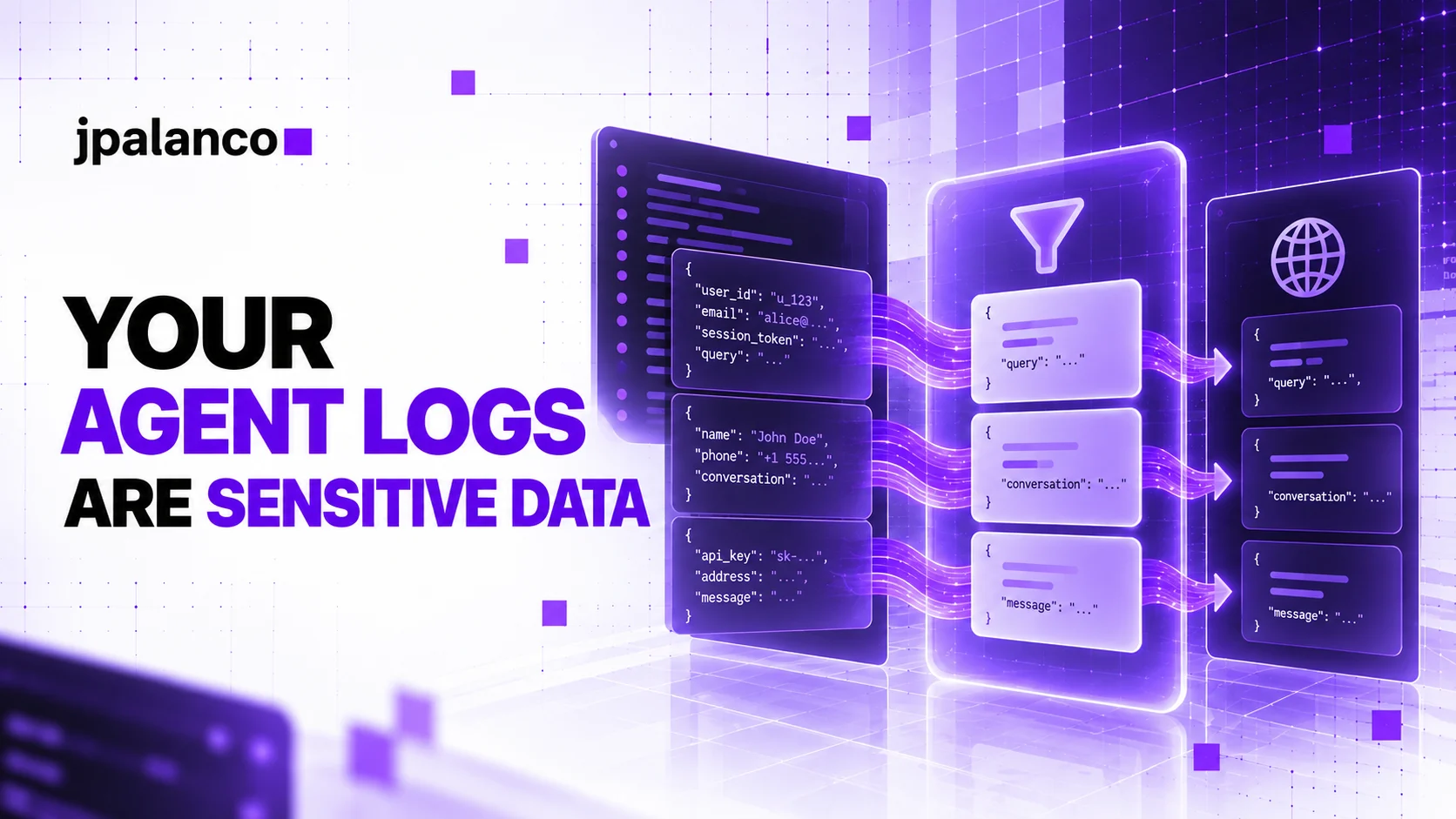
Proposed control flow for your own review. This illustration is not Warp’s incident architecture.
The filter in that diagram should operate before a record reaches a destination that does not need its raw contents. Redaction after export cannot remove a copy already stored by another system.
There is no universal list of fields to remove. A repository path can identify an unreleased project; a command argument can contain a customer identifier; a seemingly harmless error can include a signed URL. Start with the workflow’s real field schema, then justify each field against the question the log must answer.
Warp documents secret-redaction controls and its privacy guide distinguishes telemetry payload handling from terminal or AI content redaction. Treat that as a reason to test each route separately, rather than assuming one switch covers every export.
Test with canaries, not production secrets
I would validate the proposed configuration using an isolated account, a disposable repository and synthetic values. This is a test plan, not an experiment I have run against Warp.
Create a unique harmless marker for a repository path, a fake customer identifier and a credential-shaped string that cannot authenticate anywhere. Run the smallest workflow that exercises the feature. Inspect the available network log, stored conversation, exported diagnostics and administration reports for those markers.
A marker’s absence in one view proves only that it was absent from that view. It does not prove a processor never received it. Use the observation to ask a precise follow-up about the relevant backend record and its retention policy.
Then delete the disposable session and test the documented deletion path. Record what disappears immediately, what is retained for a stated reason and which copies need a separate request. A successful button click is not evidence that every backup or processor copy has disappeared.
Give incident response a field-level starting point
If your provider sends an incident notice, preserve its wording and separate confirmed facts from open questions. Identify the affected feature and configured record types before treating every connected repository or credential as exposed.
Ask for the incident’s data categories, relevant time window, affected processors and recommended actions. Compare that answer with your own usage and retention records. If you have evidence that a real secret entered an affected record, revoke or rotate it through your normal incident process. An unknown payload does not justify asserting a confirmed theft in a public post or an internal incident timeline.
The same discipline helps avoid false reassurance. “Only logs” is not a useful severity classification until somebody has established what those logs contain and who could use it.
Keep the record small enough to defend
Yesterday’s SkillSpector review addressed what enters an agent through a skill. The earlier task-permissions article addressed what the agent may do. Logging is a third decision: what persists after the task ends.
I would approve an agent workflow with an explicit record inventory, bounded retention, named readers and a tested deletion process. Those controls make the evidence useful without quietly turning every debugging session into another long-lived copy of development data.
If you are reviewing an AI development tool, get in touch with one workflow and its data destinations. That is a concrete starting point for deciding what the product should remember.